
January 23, 2026
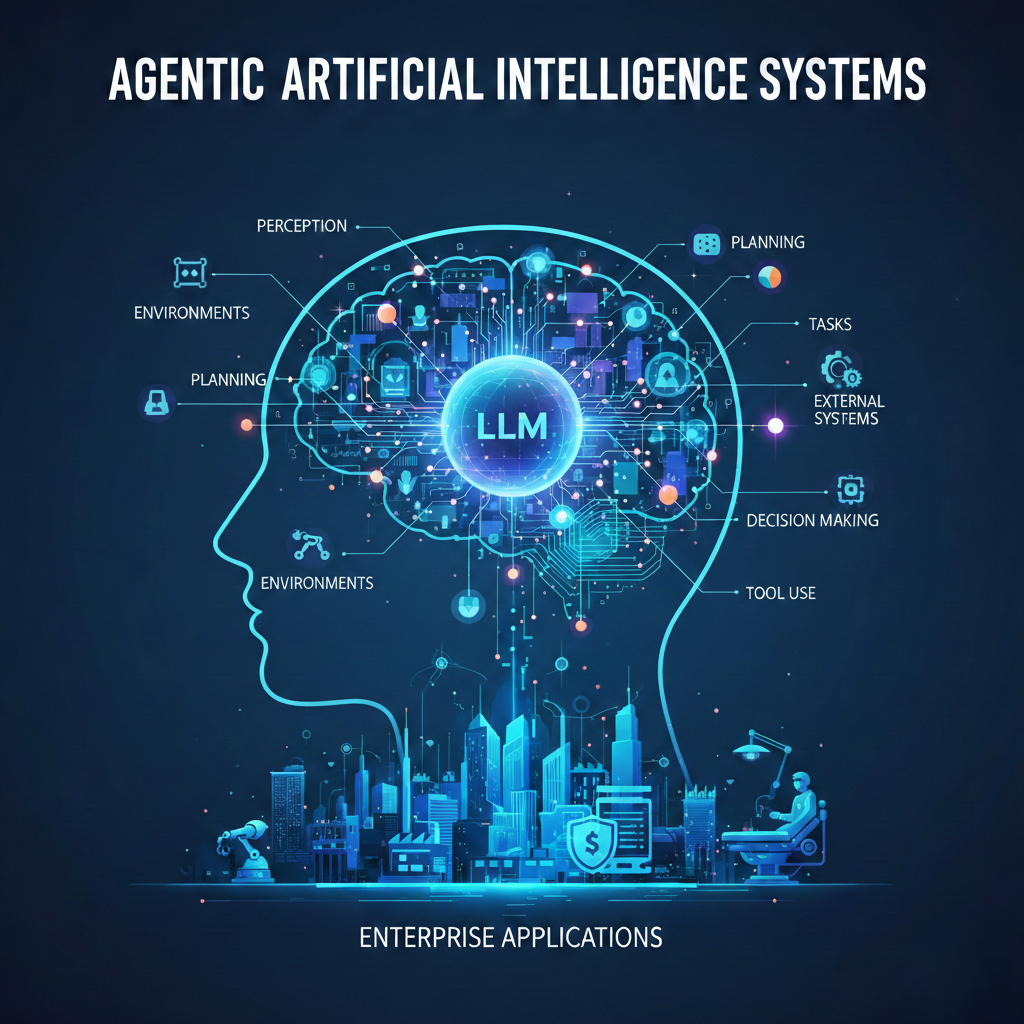
Agentic AI Systems refer to intelligent software entities that can perceive environments, reason about them, plan actions, maintain memory, make decisions, and autonomously execute tasks using AI models—especially Large Language Models (LLMs).
These systems represent a shift from passive AI to active digital workers and decision-makers, enabling automation of complex workflows in enterprises, research, cybersecurity, healthcare, finance, and more.
An AI agent is an intelligent system designed to interact with an environment and achieve specific goals. According to Russell and Norvig in Artificial Intelligence: A Modern Approach, an intelligent agent is one that acts appropriately for its circumstances and goals, adapts to changing environments, learns from experience, and makes rational decisions given its limitations.
Key characteristics of AI agents include:
These characteristics distinguish agents from traditional software programs that follow static rules.
Machine Learning (ML) and Reinforcement Learning (RL) played a foundational role in the development of AI agents. Early agents relied heavily on RL, where systems learned to make decisions through trial and error by receiving rewards or penalties.
Frameworks like OpenAI Gym (now Gymnasium under the Farama Foundation) provided standardized environments for training agents in robotics, games, simulations, and control systems.
RL-based agents demonstrated the ability to:
However, traditional RL agents required extensive training, large datasets, and computational resources, limiting their practical enterprise deployment.
Large Language Models have revolutionized agentic AI by enabling natural language reasoning, planning, and interaction. Unlike earlier agents that relied on structured environments, LLM-based agents can operate in unstructured digital environments such as the web, enterprise systems, and human workflows.
Key impacts of LLMs on agentic AI include:
LLMs have accelerated the adoption of agentic AI across industries and enabled the creation of digital assistants, autonomous workflows, and AI copilots.
Enterprises are rapidly adopting agentic AI to automate operations, enhance productivity, and reduce operational costs. According to Gartner, by 2028, 33% of enterprise software applications will utilize agentic AI, enabling 15% of day-to-day work decisions to be made autonomously.
Enterprise use cases include:
This trend indicates a shift toward AI-driven enterprises, where human employees collaborate with autonomous AI agents.
One of the defining features of agentic AI is its ability to plan and reason about tasks. Modern agents use patterns like Reason + Act (ReAct), where the system alternates between reasoning steps and action execution.
Planning capabilities include:
In LLM-based agents, the language model acts as the control logic engine, deciding which tools to call and what actions to take.
Modern agentic systems use advanced reasoning techniques to handle complex tasks and reduce errors.
Reflection allows agents to evaluate past actions and outcomes to improve future decisions. The Self-Critic mechanism enables agents to analyze their own reasoning and correct mistakes.
Chain-of-Thought (CoT) reasoning involves breaking down complex problems into step-by-step logical sequences. This improves transparency and accuracy in multi-step tasks such as mathematical reasoning, planning, and coding.
Subgoal decomposition divides a main objective into smaller tasks or milestones. This hierarchical planning approach enables agents to handle large, complex workflows autonomously.
These techniques significantly improve agent reliability and decision quality.
Memory is a critical component of intelligent agents. Unlike stateless chatbots, agentic AI systems maintain state and context across interactions.
Session-based memory stores information during a single interaction or workflow, such as previous steps and tool outputs.
Persistent memory stores historical data across sessions, enabling agents to learn user preferences, organizational context, and past experiences.
Memory allows agents to:
Agentic AI systems are not limited to generating text—they can take real-world actions. Agents can call tools, APIs, databases, and external systems to complete tasks autonomously.
Examples of tool use include:
The Model Context Protocol (MCP) defines a standardized interface connecting agents (clients) with tools (servers), enabling interoperability and modular system design.
Tool use transforms agents from passive assistants into autonomous digital workers.
Developers increasingly rely on agentic AI frameworks to build, orchestrate, and deploy agents efficiently.
Popular frameworks include:
These frameworks provide reusable components for memory, tool integration, orchestration, and reasoning, significantly reducing development time and complexity.
Agentic systems vary in their level of autonomy based on orchestration design.
Agents follow predefined scripts and rules with limited flexibility.
Finite State Machine (FSM) workflows allow agents to transition between predefined states based on conditions, offering controlled autonomy.
These agents make decisions dynamically based on model reasoning and interactions, with minimal human intervention.
Different autonomy levels are chosen based on risk, compliance, and business requirements.
Agentic Artificial Intelligence Systems represent the next major evolution in AI technology. By combining perception, reasoning, memory, planning, and action capabilities, these systems move beyond passive AI models toward autonomous digital agents capable of executing complex workflows.
In the coming years, agentic AI will redefine how humans interact with technology, shifting from manual control to collaborative partnerships between humans and intelligent autonomous agents.


