
February 1, 2026
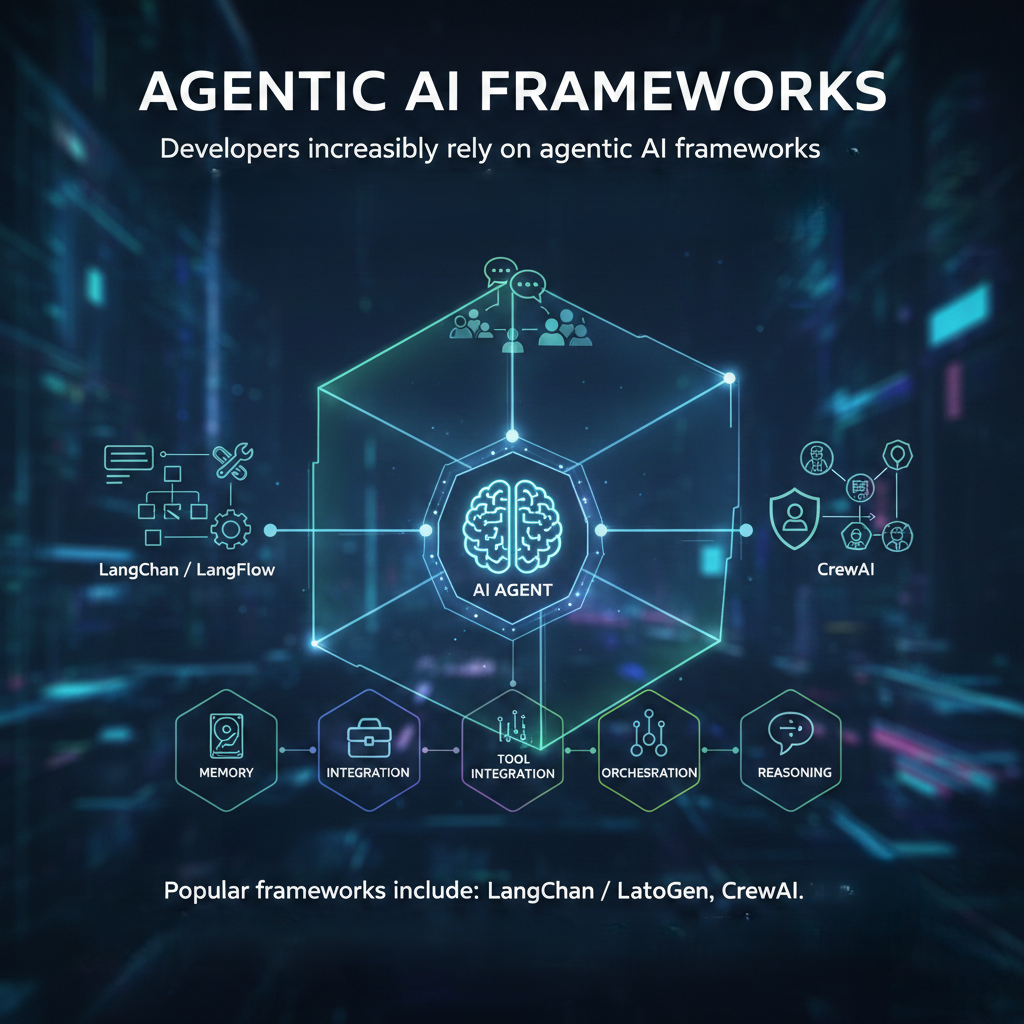
Building an agentic AI system involves multiple complex components such as planning logic, memory management, tool invocation, and multi-agent coordination. Agentic AI frameworks abstract much of this complexity and provide structured patterns for rapid development.
Key benefits of agentic AI frameworks include:
Frameworks enable developers and enterprises to focus on business logic rather than low-level infrastructure.
LangChain is one of the most popular frameworks for building LLM-powered applications and agents. It provides abstractions for prompts, chains, tools, memory, and retrieval-augmented generation (RAG).
LangFlow is a visual orchestration layer on top of LangChain that allows users to design agent workflows using a graphical interface.
Key capabilities:
LangChain and LangFlow are widely used in enterprise prototypes and production systems.
AutoGen is a framework designed for multi-agent collaboration. It enables multiple AI agents to communicate, negotiate, and collaborate to solve complex tasks.
Key capabilities:
AutoGen is particularly useful for complex workflows such as software development, research automation, and enterprise decision-making.
CrewAI focuses on role-based multi-agent teams working toward shared goals. Each agent is assigned a specific role (e.g., researcher, analyst, developer), and tasks are distributed among agents collaboratively.
Key capabilities:
Beyond LangChain, AutoGen, and CrewAI, the agentic AI ecosystem includes:
These frameworks are evolving rapidly as agentic AI becomes a core enterprise technology.
Agentic AI frameworks accelerate enterprise adoption by providing production-ready building blocks. Organizations can:
Frameworks reduce development complexity and lower the barrier to entry for agentic AI adoption.
Agentic AI frameworks such as LangChain, LangFlow, AutoGen, and CrewAI play a critical role in enabling the development of intelligent, scalable, and collaborative AI agents.
To explore the full capabilities, enterprise trends, and technical foundations of agentic AI, read the blog “Agentic Artificial Intelligence Systems.”
Related Links:
Role of machine learning and reinforcement learning
Impact of Large Language Models (LLMs)
Memory and statefulness in Agentic AI system
Levels of Autonomy and Orchestration in Agentic AI Systems


