
January 31, 2026
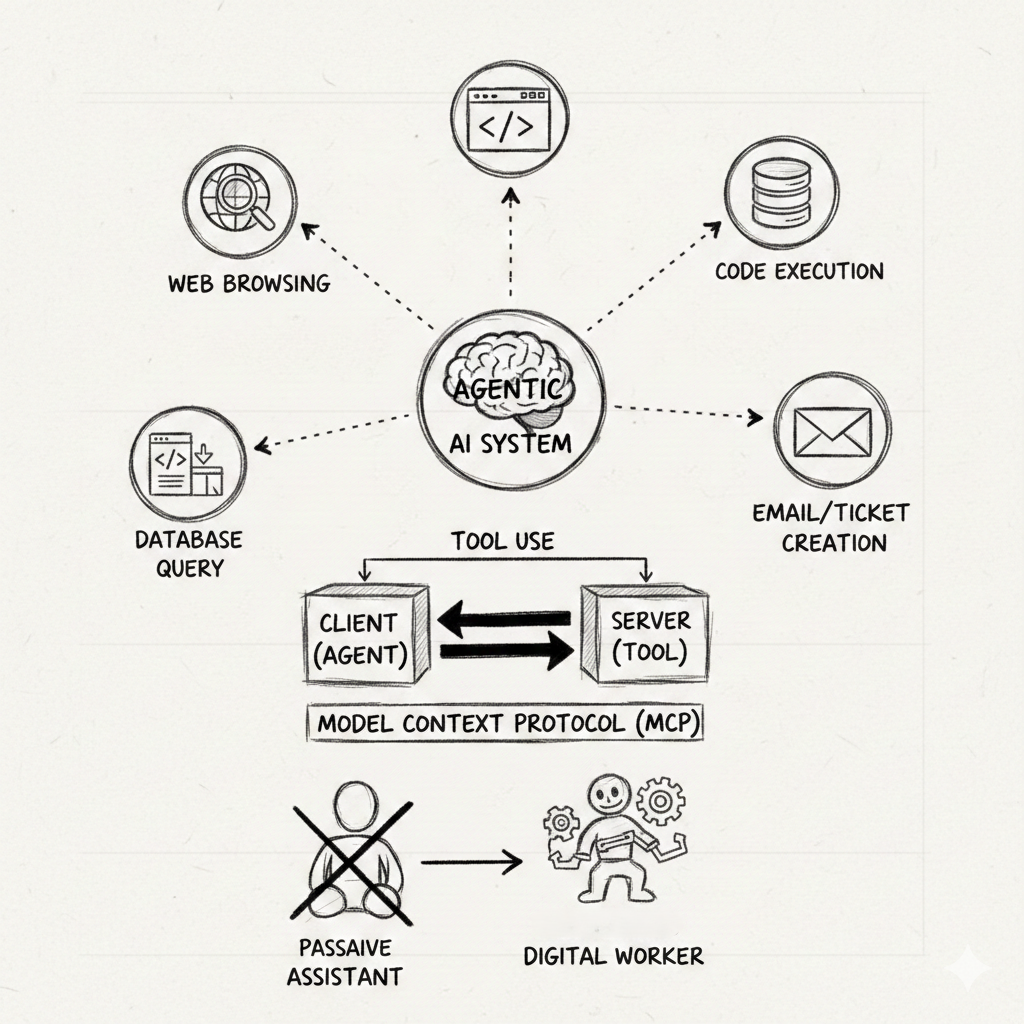
Tool use refers to an agent’s ability to invoke external systems, APIs, databases, and software tools to accomplish tasks. In this paradigm, the AI model acts as a decision-making engine that determines which tool to use, when to use it, and how to interpret the results.
Unlike static automation scripts, agentic systems dynamically choose tools based on context, goals, and constraints, making them adaptive and intelligent.
Agentic AI systems can perform a wide range of actions across digital environments. Common examples include:
Web Browsing and Information Retrieval
Agents can browse the web, extract relevant information, summarize content, and verify facts in real time.
Code Execution and Automation
Agents can generate and execute code for data processing, machine learning workflows, infrastructure automation, and system diagnostics.
Database and Enterprise System Queries
Agents can query structured databases, ERP systems, CRM platforms, and knowledge bases to retrieve or update records.
Enterprise Workflow Automation
Agents can send emails, create service tickets, schedule meetings, update dashboards, and trigger business workflows autonomously.
These capabilities transform AI systems into digital workers capable of performing operational tasks without human intervention.
The Model Context Protocol (MCP) defines a standardized interface for connecting AI agents (MCP Clients) with external tools and services (MCP Servers). MCP enables modular, secure, and scalable tool integration by defining how agents discover, invoke, and interpret tools.
Key benefits of MCP include:
MCP represents an important step toward building open, extensible agent ecosystems.
Tool use transforms AI systems from passive assistants into autonomous digital workers. Instead of only providing recommendations, agents can:
This shift marks a fundamental change in how organizations deploy AI—from decision support to autonomous execution.
Tool-enabled agents are already being used in enterprises for:
These applications demonstrate the operational impact of agentic AI in real-world environments.
Action and tool use are foundational capabilities of agentic AI systems.
Protocols like MCP standardize these interactions and enable scalable, secure agent architectures.
To explore planning, memory, frameworks, and enterprise adoption of agentic AI, read the blog “Agentic Artificial Intelligence Systems.”
Related Links:
Role of machine learning and reinforcement learning
Impact of Large Language Models (LLMs)
Memory and statefulness in Agentic AI system
Levels of Autonomy and Orchestration in Agentic AI Systems


