
January 28, 2026
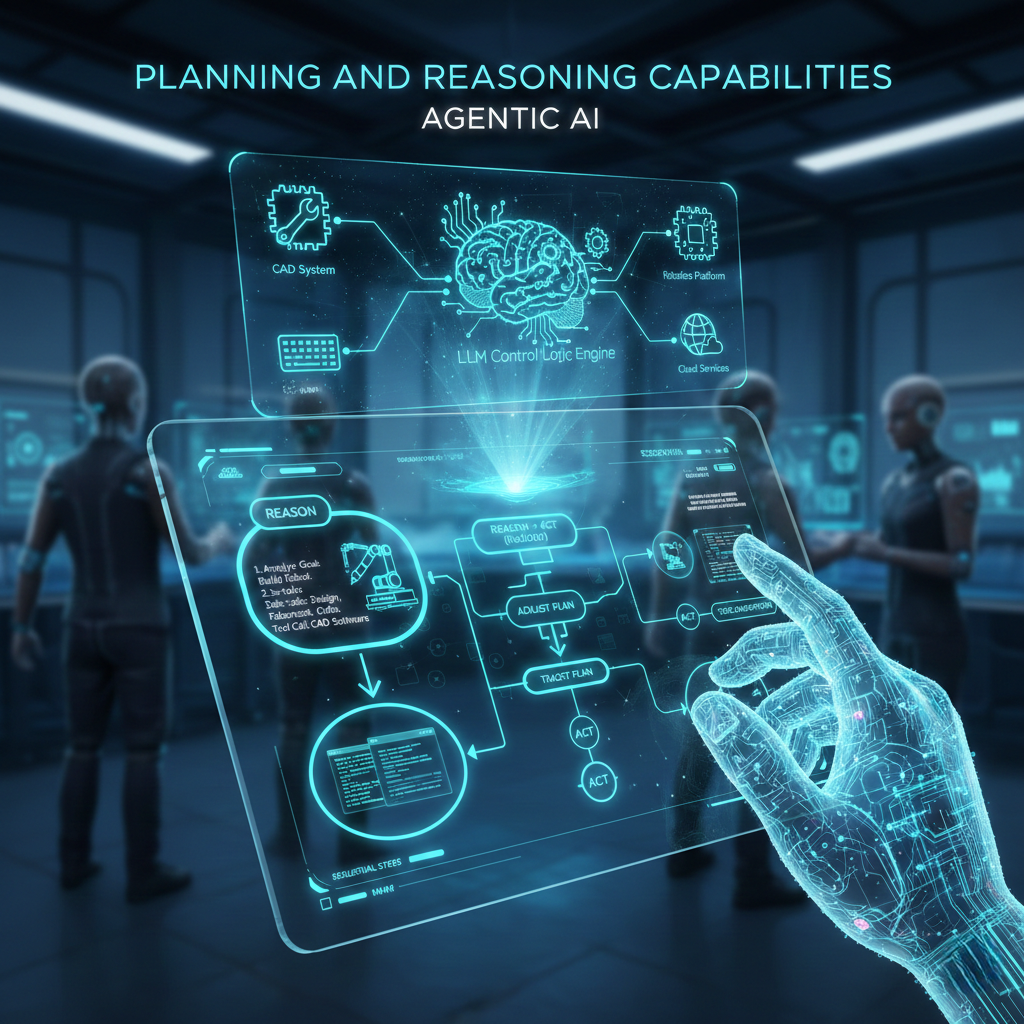
Planning and reasoning are cognitive capabilities that allow an AI agent to decide what to do, how to do it, and when to do it. These capabilities are inspired by human problem-solving processes and are essential for autonomous decision-making.
In agentic AI, these two capabilities work together to enable intelligent behavior.
One of the most influential paradigms in modern agentic AI is the Reason + Act (ReAct) pattern. In this pattern, an agent alternates between reasoning steps and action execution.
This iterative loop enables agents to handle complex workflows, uncertainty, and dynamic environments.
Agents can break down complex tasks into smaller, manageable steps or subgoals. This process is known as subgoal decomposition.
Example: An AI research assistant breaks down a literature review task into searching papers, summarizing findings, and compiling a report.
Agentic systems track progress toward goals and adjust their strategies as tasks evolve. This capability allows agents to manage long-running workflows and multi-step processes.
Example: A project management agent monitors task completion and updates timelines based on real-time progress.
Agents can modify their plans when new information becomes available or when unexpected events occur. This adaptability is crucial in real-world environments.
Example: A logistics agent reroutes shipments when a delivery route becomes unavailable.
Modern agents orchestrate multiple tools, APIs, databases, and software systems to accomplish tasks. Planning includes deciding which tools to use and in what order.
Example: A data analytics agent retrieves data from a database, processes it using Python, and visualizes results in a dashboard.
In LLM-based agents, the language model acts as the control logic engine that drives planning and reasoning. The LLM interprets user instructions, evaluates context, selects tools, and determines the sequence of actions.
This architecture enables agents to operate as autonomous workflow engines, not just conversational interfaces.
Agents automate complex business processes such as financial reporting, compliance checks, and supply chain optimization by planning multi-step workflows.
AI agents diagnose system issues, plan remediation actions, and execute automated fixes in IT environments.
Agents assist researchers by planning literature reviews, analyzing datasets, and generating structured reports.
Agents manage calendars, schedule meetings, and plan tasks based on user preferences and priorities.
Despite their capabilities, agentic planning and reasoning face several challenges:
To mitigate these risks, organizations implement validation layers, human-in-the-loop oversight, and constrained execution environments.
Planning and reasoning capabilities are at the core of agentic AI, enabling systems to move beyond static responses toward autonomous decision-making and action execution.
As highlighted in the blog “Agentic Artificial Intelligence Systems”, planning and reasoning transform AI agents into intelligent digital workers capable of executing real-world tasks with minimal human intervention.
Related Links:
Role of machine learning and reinforcement learning
Impact of Large Language Models (LLMs)
Action and Tool Use in Agentic AI Systems
Levels of Autonomy and Orchestration in Agentic AI Systems


