
January 24, 2026
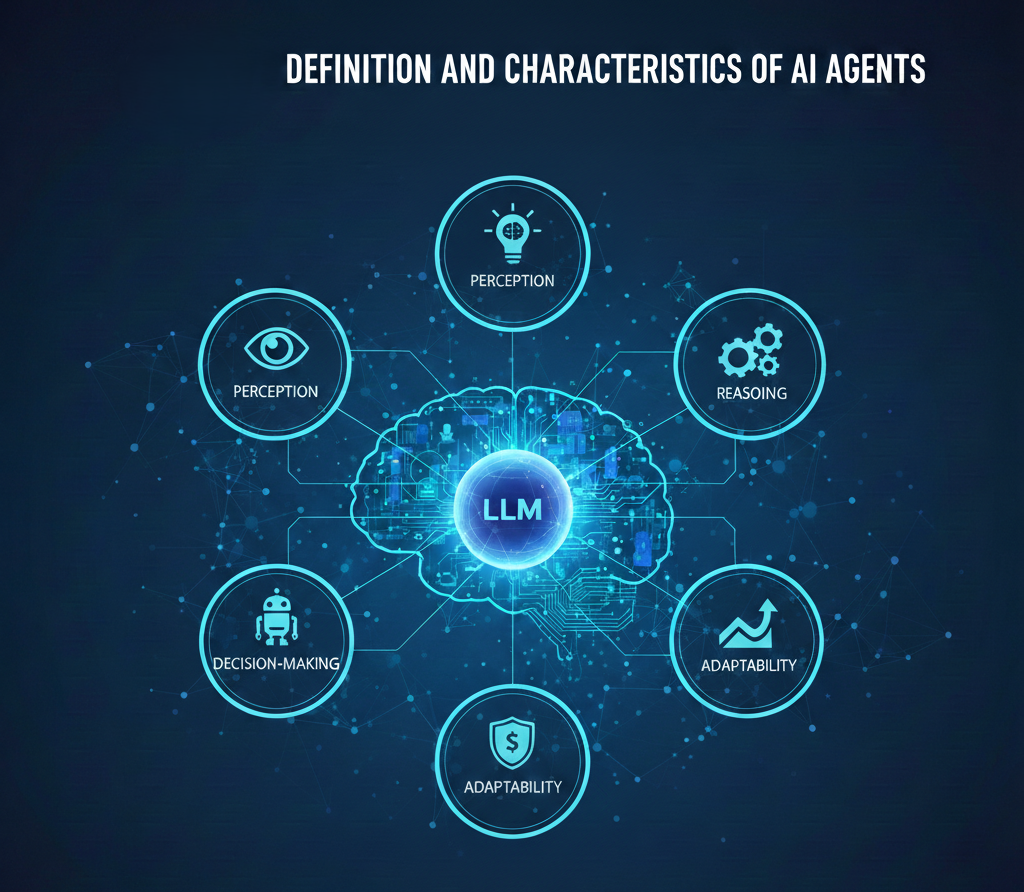
An AI agent is an intelligent system designed to perceive its environment, reason about information, make decisions, and take actions to achieve specific goals. Unlike traditional software programs that follow static instructions, AI agents operate dynamically and adapt to changing conditions.
According to Russell and Norvig in Artificial Intelligence: A Modern Approach, an intelligent agent is a system that:
This definition remains the cornerstone of agent-based AI research and development.
AI agents are distinguished by several key characteristics that enable them to function autonomously and intelligently.
Perception refers to an agent’s ability to sense and interpret data from its environment. The environment may be physical or digital, including sensors, cameras, system logs, APIs, databases, and user inputs.
In modern systems, perception includes natural language understanding, image recognition, and structured data interpretation. Effective perception allows agents to build an internal representation of the world and respond appropriately.
Example: A smart home agent perceives temperature, motion, and user commands to control lighting and climate systems.
Reasoning is the cognitive process that enables agents to analyze information, infer relationships, and draw conclusions. AI agents use various reasoning techniques, including symbolic reasoning, probabilistic reasoning, and neural reasoning powered by large language models.
Advanced reasoning techniques such as Chain-of-Thought, Reflection, and Self-Critique improve the accuracy and reliability of agent decisions.
Example: A medical diagnostic agent reasons about patient symptoms, lab results, and medical knowledge to suggest possible diagnoses.
Decision-making involves selecting the best action from multiple alternatives based on goals, constraints, and environmental context. Agents may use rule-based logic, reinforcement learning policies, optimization algorithms, or LLM-driven planning.
Decision-making enables agents to prioritize tasks, allocate resources, and adapt strategies dynamically.
Example: A financial trading agent decides when to buy or sell assets based on market trends and risk parameters.
Autonomy refers to the degree to which an agent can operate independently without human intervention. Fully autonomous agents can initiate actions, adjust strategies, and complete tasks on their own, while semi-autonomous agents operate under human supervision.
Autonomy is essential in applications such as autonomous vehicles, enterprise automation, robotics, and cybersecurity systems.
Example: A cybersecurity agent autonomously detects threats and initiates mitigation actions such as isolating infected systems.
Adaptability is the ability of an agent to learn from experience and improve over time. Learning mechanisms include reinforcement learning, supervised learning, continual learning, and memory-based learning in LLM systems.
Adaptive agents personalize interactions, optimize workflows, and evolve in dynamic environments.
Example: A recommendation agent learns user preferences and adapts content suggestions accordingly.
Modern agentic systems extend beyond classical characteristics with advanced capabilities enabled by LLMs and distributed architectures.
Agents operate with explicit or implicit goals and dynamically adjust strategies to achieve them.
Agents can anticipate user needs and initiate actions without explicit prompts.
Multi-agent systems involve multiple agents working together to solve complex tasks.
Advanced agents provide explanations for decisions, improving trust and compliance.
Traditional software follows deterministic rules and static workflows. It cannot learn, reason, or adapt beyond predefined logic. AI agents differ by offering:
These features position AI agents as intelligent digital entities rather than conventional programs.
AI agents can be classified into several categories based on their capabilities:
Modern LLM-based agents often combine multiple categories, creating hybrid intelligent systems.
AI agents are transforming multiple industries:
AI agents represent a fundamental shift in artificial intelligence—from passive systems that respond to commands to autonomous entities capable of perceiving, reasoning, learning, and acting independently.
For a comprehensive overview of agent capabilities, enterprise adoption, frameworks, and autonomy models, read the blog “Agentic Artificial Intelligence Systems”.
Related Links:
Impact of Large Language Models (LLMs)
Enterprise Adoption and Gartner Forecast


