
January 26, 2026
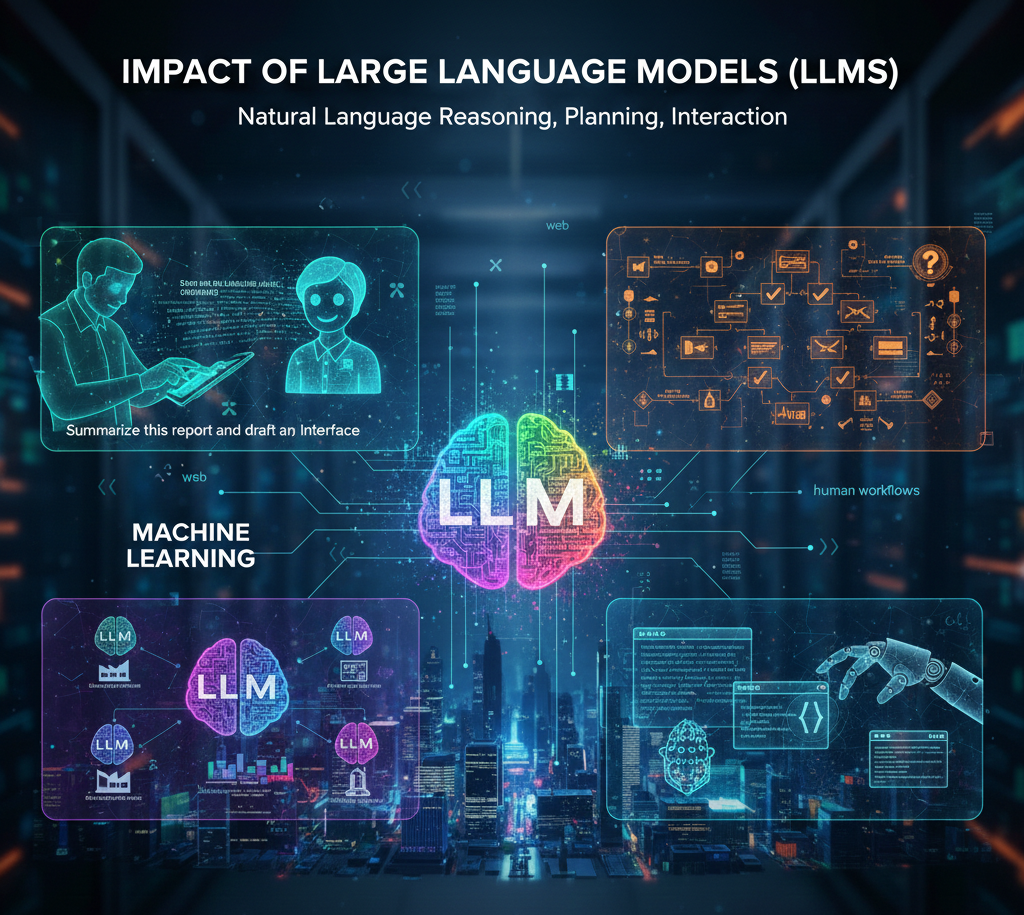
Traditional AI agents operated in highly structured environments such as simulations, robotics control systems, or predefined enterprise workflows. These systems required extensive domain-specific training and manual configuration.
LLMs changed this paradigm by enabling agents to operate in unstructured digital environments, including:
By understanding and generating natural language, LLM-based agents can interact with humans and systems in a flexible and intuitive way, reducing the need for domain-specific engineering.
One of the most significant impacts of LLMs is the ability to provide a natural language interface for AI agents. Users can communicate with agents using everyday language, eliminating the need for technical commands or structured queries.
Example: A business user can ask an AI agent, “Generate a quarterly financial report and email it to the leadership team,” and the agent can interpret and execute the task.
LLMs introduced advanced reasoning capabilities that allow agents to perform complex, multi-step tasks. Techniques such as Chain-of-Thought reasoning, Reflection, and Self-Critique enable agents to break down problems, evaluate outcomes, and refine their solutions.
Example: A software development agent can analyze requirements, generate code, test it, debug errors, and refine the solution iteratively.
Unlike traditional AI models that require retraining for each domain, LLMs are general-purpose models capable of performing tasks across multiple industries and domains with minimal customization.
Example: The same LLM-based agent can be used for customer support, HR automation, cybersecurity analysis, and data analytics with minimal configuration.
LLMs have enabled agents to interact with external tools and systems through API calls, code execution, databases, and enterprise software platforms. This capability transforms agents from conversational assistants into action-oriented digital workers.
The introduction of protocols like the Model Context Protocol (MCP) and function-calling architectures standardized tool integration, enabling modular and interoperable agent ecosystems.
LLMs have significantly accelerated the adoption of agentic AI in both consumer and enterprise settings. Organizations are deploying LLM-based agents for:
The flexibility and scalability of LLM-based agents have reduced barriers to entry and enabled rapid innovation across sectors.
Despite their transformative impact, LLM-based agents introduce new challenges:
Addressing these challenges requires governance frameworks, monitoring, human-in-the-loop systems, and robust security controls.
Large Language Models have revolutionized agentic AI by enabling natural language interaction, advanced reasoning, scalability across domains, and seamless integration with tools and enterprise systems.
As discussed in the blog “Agentic Artificial Intelligence Systems”, LLMs are the primary catalyst driving the modern wave of agentic AI adoption.
Related Links:
Role of machine learning and reinforcement learning
Enterprise Adoption and Gartner Forecast
Action and Tool Use in Agentic AI Systems
Levels of Autonomy and Orchestration in Agentic AI Systems


