Introduction
For SaaS companies in Cloud Security and Analytics, the promise of AI is clear: give customers smarter, faster, and more intuitive ways to interact with data. But as many executives discover, the challenge isn’t just choosing the right Large Language Model (LLM). It’s about building the right AI architecture—one that can adapt to your product, scale with your users, and stay compliant with enterprise standards.
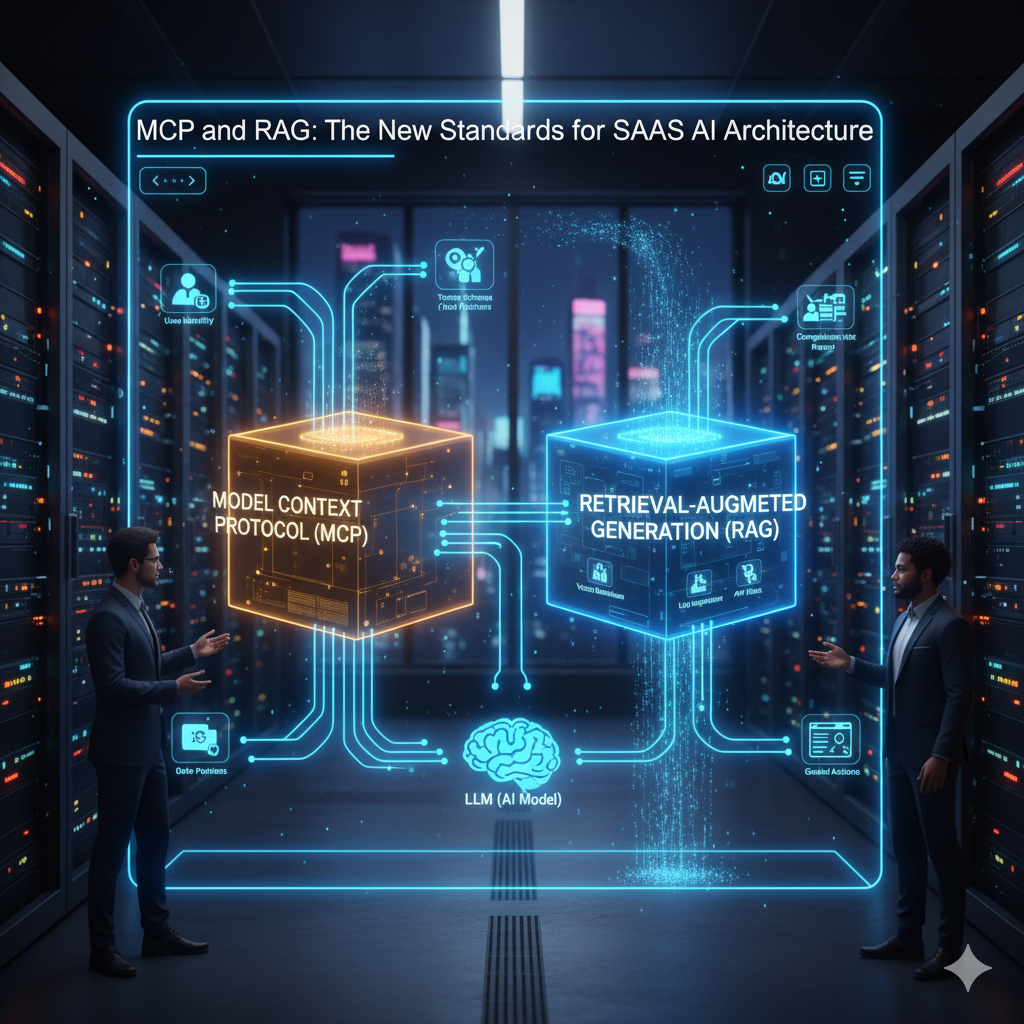
Two emerging pillars are redefining how SaaS products embed AI:
- Model Context Protocol (MCP) – a universal adapter that standardizes how applications feed context into LLMs.
- Retrieval-Augmented Generation (RAG) – a technique that grounds AI responses in relevant, external data sources for accuracy and trustworthiness.
Together, MCP and RAG are setting the bar for next-generation SaaS AI design. In this post, we’ll unpack how they work, why they matter, and how your platform can leverage them to deliver enterprise-ready AI assistants.
The Context Problem in SaaS AI
Out-of-the-box LLMs are powerful but context-blind:
- They don’t know your product’s database schema.
- They don’t understand your compliance frameworks.
- They don’t have access to your customers’ live data.
This leads to hallucinations—AI making things up—or generic answers that don’t solve real user problems.
For example:
- A security SaaS user asks: “Show me all IAM policy changes that could break PCI DSS compliance.”
- A base model might reply with PCI guidelines in general.
- But it won’t know which specific policies in your customer’s tenant are relevant.
This is where MCP and RAG bridge the gap.
What is Model Context Protocol (MCP)?
MCP is a standardized way for SaaS platforms to pass context into AI systems. Think of it as a universal adapterbetween your application and an LLM.
How it works:
- Schema Awareness: MCP tells the AI about your product’s APIs, data schemas, and domain rules.
- Context Injection: Every query a user makes comes bundled with metadata—tenant, role, permissions, product context.
- Consistent Interfaces: Whether you’re using AWS Bedrock, Azure OpenAI, or GCP Vertex AI, MCP ensures the AI “speaks the same language” across all.
Benefits:
- Portability: Swap LLM providers without re-engineering your integrations.
- Security: Standardized access control reduces risks of over-exposure.
- Scalability: Multiple agents can share the same context framework, enabling an Agent Chain architecture.
What is Retrieval-Augmented Generation (RAG)?
RAG addresses the knowledge gap by letting the AI pull in external data at query time. Instead of relying only on what it memorized during training, the AI retrieves relevant documents, logs, or reports—and then generates a grounded response.
How it works:
- User Query: “List all anomalous login attempts in the last 30 days.”
- Retriever: Pulls relevant log slices or audit records from your backend.
- Generator: AI crafts a response based on both the user query and the retrieved data.
- Output: A precise, data-backed answer—possibly with a chart or table.
Benefits:
- Accuracy: Reduces hallucinations by grounding answers in real data.
- Freshness: Always uses the latest available information.
- Flexibility: Supports multiple data sources—databases, object storage, internet search.
Why MCP + RAG is a Winning Combo
Individually, MCP and RAG solve different problems. Together, they form the blueprint of modern SaaS AI architecture:
- MCP ensures the AI understands your product’s world (APIs, schemas, permissions).
- RAG ensures the AI answers with the right, up-to-date data.
This combination enables assistants that are not just conversational, but actionable and reliable.
For example, in a cloud analytics SaaS:
- MCP tells the AI how your anomaly detection API works.
- RAG fetches the actual anomaly data from the last 90 days.
- The assistant responds with:
“Here’s a time-series chart of login anomalies in the EU region. The biggest spike was on Sept 14, caused by failed logins from 200+ distinct IPs. Recommended next step: enable IP rate-limiting.”
That’s not just an answer—it’s insight plus action.
Use Cases for Security & Analytics SaaS
- Compliance Reporting
- MCP provides knowledge of compliance mappings.
- RAG retrieves relevant logs.
- Users get tailored compliance reports instantly.
- Threat Hunting
- MCP guides the assistant to use your security query APIs.
- RAG pulls log evidence.
- Users get anomaly insights with supporting data.
- Capacity Planning
- MCP defines schema for resource metrics.
- RAG retrieves historical usage data.
- Users get trend charts and predictive analytics.
Technical Architecture: MCP + RAG in Action
A typical architecture might look like this:
- User Interface: Conversational UI inside your SaaS dashboard.
- Agent Chain:
- Parser Agent: Interprets user queries.
- Retriever Agent: Uses RAG to fetch relevant slices of data.
- Executor Agent: Calls APIs defined via MCP.
- Visualizer Agent: Renders charts (React, Mermaid, HTML).
- Authentication Layer: LDAP, OAuth2, or email verification.
- Deployment Options: Local (for sensitive data) or Cloud (for scale).
This multi-agent, context-rich approach ensures reliability, security, and adaptability.
Why SaaS Executives Should Care
For product and engineering leaders, adopting MCP and RAG unlocks:
- Faster Innovation: Build once, plug into multiple AI providers.
- Lower Costs: Reduce support tickets with self-service AI.
- Stronger Stickiness: Users rely on your platform for decision-making, not just data.
- Future-Proofing: Stay ahead as AI standards evolve.
In short: MCP and RAG are no longer “nice-to-haves”—they’re table stakes for AI-powered SaaS.
Getting Started with Doc-E.ai
At Doc-E.ai, we make MCP and RAG integration seamless for SaaS teams. With our no-code AI assistants and enterprise-ready deployment options, you can:
- Standardize your AI integrations with MCP.
- Ground responses in live customer data with RAG.
- Deliver trustworthy, action-oriented AI experiences directly in your dashboard.
👉 Book a Demo today to see how MCP and RAG can elevate your SaaS AI stack.