
February 22, 2026
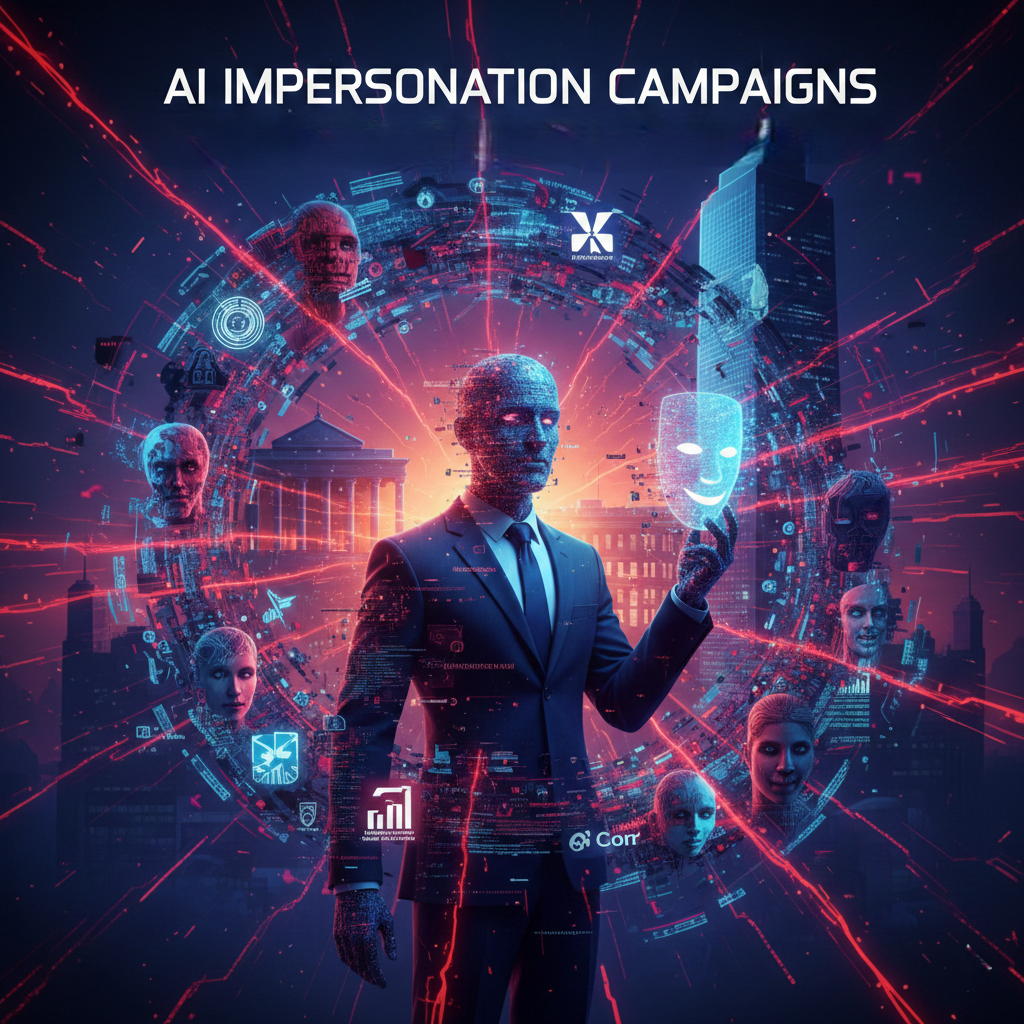
AI impersonation campaigns use AI-generated text, voice, and video to mimic real individuals. Attackers leverage deepfake technology, large language models, and voice synthesis tools to create convincing fake communications.
These campaigns can target:
The goal is to deceive victims into revealing confidential information or taking harmful actions.
Attackers clone a person’s voice using publicly available recordings. The synthetic voice is used in phone calls to instruct employees to transfer funds or share confidential data.
Large language models generate highly convincing emails and messages that mimic a person’s writing style. These messages can instruct employees to perform urgent tasks or share sensitive information.
Deepfake videos can show officials or executives making statements they never made. These videos can be used for misinformation campaigns, stock manipulation, or political destabilization.
Advanced campaigns combine voice calls, emails, chat messages, and fake documents to create highly believable attack scenarios.
Impersonation of government officials can influence diplomatic decisions, spread misinformation, or trigger geopolitical tensions.
Corporate finance teams have been tricked into transferring millions of dollars after receiving AI-generated instructions from “executives.”
Impersonation attacks can extract classified documents, trade secrets, and confidential communications.
Deepfake content undermines trust in digital communication and media, creating a “reality crisis” where people cannot distinguish real from fake.
Several organizations have reported incidents where AI-generated voice calls impersonated CEOs or CFOs to authorize fraudulent payments.
Deepfake videos and AI-generated speeches have been used to manipulate public opinion and spread disinformation during elections and geopolitical conflicts.
Government agencies have warned that foreign adversaries are using AI-generated personas to target diplomats and defense personnel for intelligence gathering.
These incidents illustrate the broader AI threat landscape discussed in “AI Security Threats and Real-World Exploits in 2026: Risks, Vulnerabilities, and Mitigation Strategies.”
Public speeches, interviews, and social media posts provide training data for voice and text cloning models.
Many organizations rely on voice or email instructions without secondary verification.
People are more likely to trust familiar voices and communication styles, making impersonation highly effective.
Open-source AI tools make impersonation technology accessible to criminals and nation-state actors.
Organizations must implement strict verification protocols for sensitive actions.
Best practices:
Secondary verification is one of the most effective defenses against impersonation.
Sensitive instructions should only be shared through secure, authenticated platforms.
Recommended measures:
Secure platforms reduce the risk of spoofed messages.
AI-based detection tools analyze audio, video, and text for signs of synthetic generation.
Capabilities include:
These tools help organizations identify and block impersonation attempts.
Human awareness is critical in preventing impersonation attacks.
Training topics should include:
Regular training reduces the success rate of social engineering attacks.
Organizations should define clear policies for sensitive communications.
Policy elements include:
Governance policies create a structured defense framework.
Emerging technologies such as voice biometrics, cryptographic identity verification, and blockchain-based identity systems can help verify authenticity of communications.
In 2026 and beyond, AI impersonation will become a strategic tool for cyber warfare, espionage, and corporate sabotage. Nation-states and organized cybercriminal groups will increasingly use AI-generated personas to manipulate decisions and extract intelligence.
Governments and enterprises must treat AI impersonation as a critical security threat, not just a technical challenge.
For a comprehensive overview of AI security threats, vulnerabilities, and mitigation strategies, explore the blog “AI Security Threats and Real-World Exploits in 2026: Risks, Vulnerabilities, and Mitigation Strategies.”
AI impersonation campaigns targeting governments and enterprises represent a major escalation in cyber and information warfare. These attacks exploit human trust, AI-generated realism, and weak verification processes to achieve financial, political, and strategic objectives.
As AI technologies continue to advance, proactive security strategies and governance frameworks will be essential to maintain trust, protect sensitive information, and ensure decision-making integrity.


