
January 30, 2026
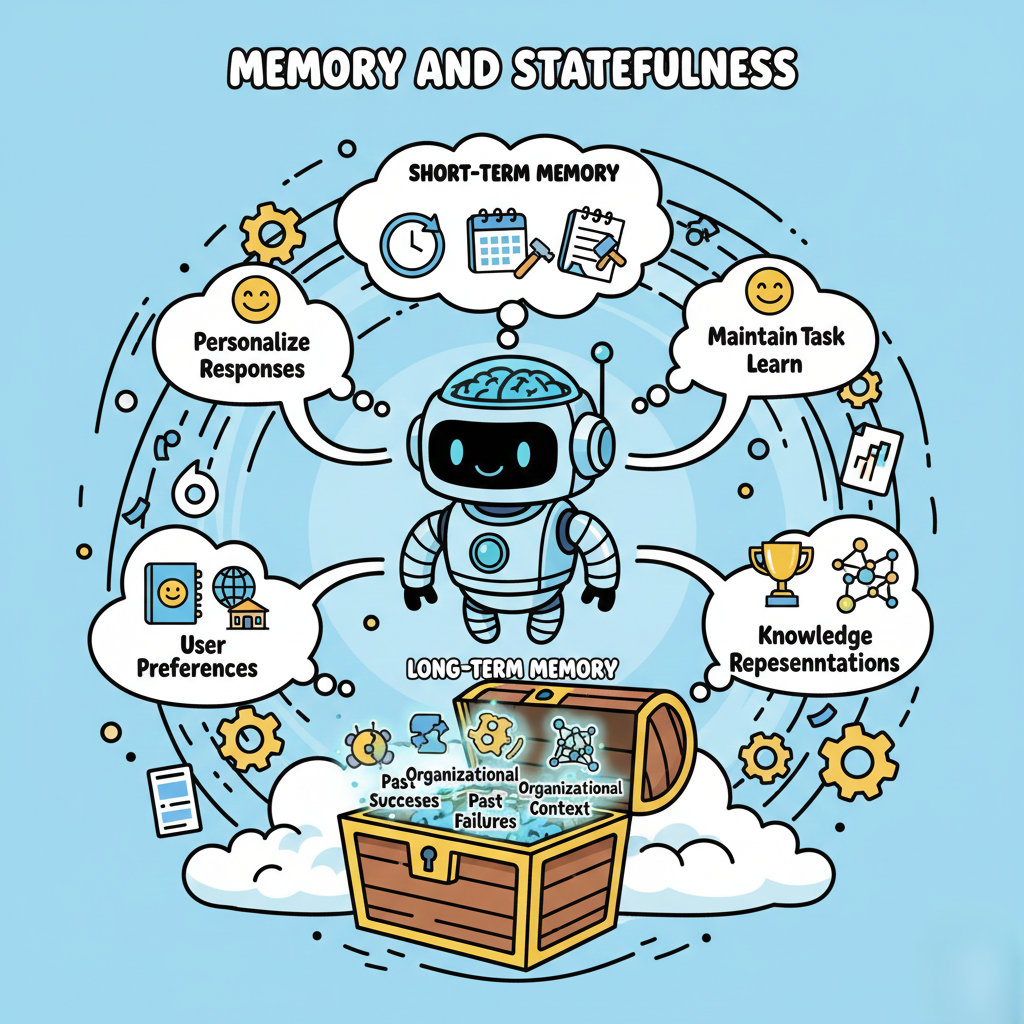
Short-term memory refers to information stored during a single session, task, or workflow. It allows agents to remember recent interactions, tool outputs, and intermediate reasoning steps.
For example, during a customer support session, an AI agent may store:
Key characteristics of short-term memory:
Short-term memory is essential for executing complex workflows, where agents must track context and progress toward a goal.
Long-term memory enables agents to retain knowledge across multiple sessions and over extended periods. This includes user preferences, organizational policies, historical decisions, and past outcomes.
Examples of long-term memory in enterprise agents include:
Key characteristics of long-term memory:
Long-term memory transforms AI agents into evolving systems that improve over time rather than resetting after each interaction.
Memory significantly enhances the capabilities of agentic AI systems. With memory, agents can:
Personalize Responses Agents tailor outputs based on user preferences, roles, and historical behavior, improving user experience and efficiency.
Maintain Task Continuity
Agents resume tasks from previous states, enabling long-running workflows such as project management, IT operations, and business automation.
Learn from Past Experiences
By analyzing past successes and failures, agents refine strategies, reduce errors, and optimize decision-making processes.
Build Knowledge Representations
Agents accumulate structured knowledge, enabling reasoning over historical data and organizational context.
Modern agentic AI systems use layered memory architectures, including:
These architectures enable scalable, secure, and interpretable memory management in enterprise deployments.
In enterprise environments, memory is crucial for building reliable and context-aware agents. Memory-driven agents can:
Memory and statefulness are foundational to creating AI systems that behave as long-term collaborators rather than short-lived tools.
Memory and statefulness are critical aspect of agentic artificial intelligence systems. Short-term memory enables contextual reasoning within sessions, while long-term memory allows agents to learn, personalize, and evolve over time.
For a complete understanding of agentic AI capabilities, frameworks, and enterprise adoption trends, explore the blog “Agentic Artificial Intelligence Systems.”
Related Links:
Role of machine learning and reinforcement learning
Impact of Large Language Models (LLMs)
Action and Tool Use in Agentic AI Systems
Levels of Autonomy and Orchestration in Agentic AI Systems


