
January 27, 2026
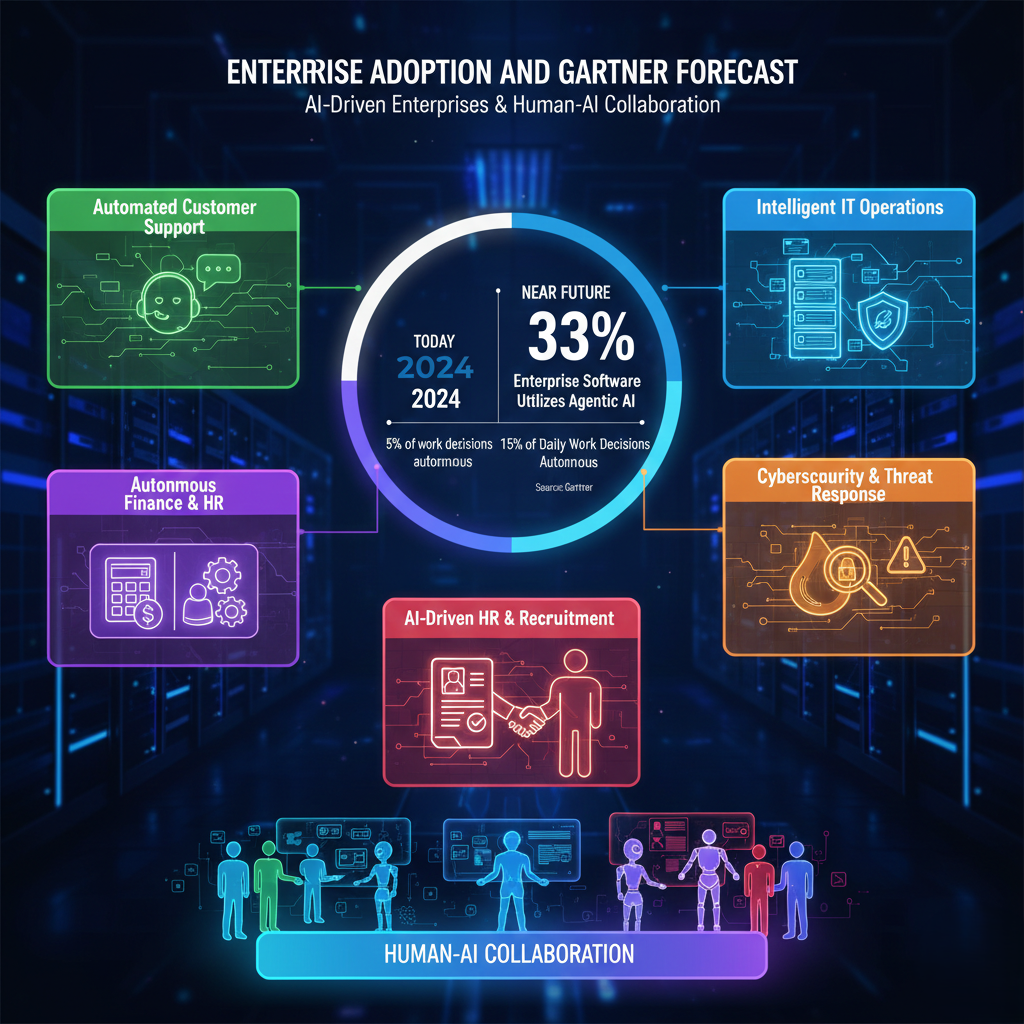
Enterprises are increasingly integrating AI agents into their digital infrastructure to streamline operations and improve decision-making. Unlike traditional automation tools, agentic AI systems can reason, plan, and act autonomously, making them suitable for complex enterprise workflows.
Key drivers of enterprise adoption include:
As organizations embrace digital transformation, AI agents are becoming core components of enterprise software ecosystems.
Gartner predicts that by 2028, 33% of enterprise software applications will utilize agentic AI, enabling 15% of day-to-day work decisions to be made autonomously. This forecast highlights a major shift from human-driven decision-making to AI-assisted and AI-driven operations.
This transformation signals the emergence of AI-first enterprises, where digital agents collaborate with human employees as virtual team members.
AI agents are widely used in customer service to handle inquiries, troubleshoot issues, process requests, and escalate complex cases. These agents operate 24/7 and significantly reduce response times and support costs.
Example: Virtual assistants in banking and e-commerce that resolve customer queries and perform transactions autonomously.
In IT operations, AI agents monitor system health, detect anomalies, and trigger automated remediation actions. Agentic systems can analyze logs, diagnose root causes, and orchestrate incident response workflows.
Example: An AI operations agent automatically restarts services, patches vulnerabilities, or escalates incidents to human engineers.
Finance departments use AI agents for invoice processing, fraud detection, expense management, financial reporting, and compliance monitoring. Agentic systems reduce manual processing and improve accuracy.
Example: An accounting agent that validates invoices, processes payments, and generates financial statements.
HR teams use AI agents for candidate screening, interview scheduling, onboarding automation, and employee engagement analysis. These agents improve recruitment efficiency and employee experience.
Example: A recruitment agent that screens resumes, ranks candidates, and schedules interviews automatically.
Cybersecurity agents monitor networks, detect threats, analyze attack patterns, and initiate mitigation actions. Autonomous agents can isolate compromised systems and generate incident reports.
Example: A security agent that detects suspicious activity and blocks malicious IP addresses in real time.
The adoption of agentic AI does not eliminate human roles; instead, it transforms them. Human employees collaborate with AI agents, focusing on strategic, creative, and supervisory tasks while agents handle routine operations.
AI agents act as digital coworkers, augmenting human capabilities rather than replacing them.
Despite the benefits, enterprises face several challenges when adopting agentic AI:
Organizations must implement governance frameworks, human-in-the-loop controls, and security policies to ensure safe deployment.
Enterprise adoption of agentic AI is accelerating as organizations seek automation, efficiency, and competitive advantage.
Gartner predicts that by 2028, one-third of enterprise software will use agentic AI, transforming business operations.
As discussed in the blog “Agentic Artificial Intelligence Systems”, agentic AI represents a shift toward AI-driven enterprises where humans and autonomous agents collaborate to achieve organizational goals.
Related Links:
Role of machine learning and reinforcement learning
Impact of Large Language Models (LLMs)
Action and Tool Use in Agentic AI Systems
Levels of Autonomy and Orchestration in Agentic AI Systems


