
January 25, 2026
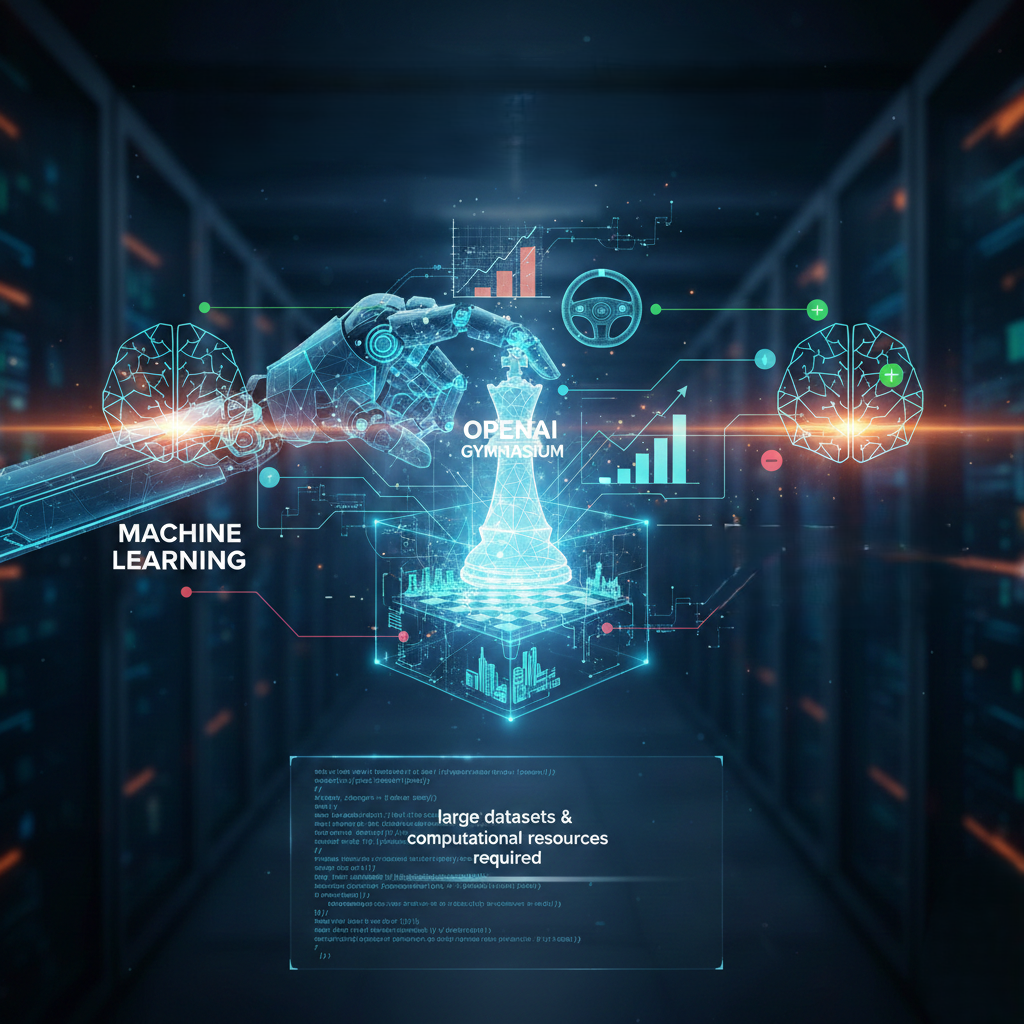
Machine Learning is a subset of artificial intelligence that enables systems to learn patterns from data and make predictions or decisions without explicit programming. In the context of AI agents, ML provides the capability to:
Early AI agents used supervised and unsupervised learning techniques to classify data, detect anomalies, and perform pattern recognition. For example, an email filtering agent learned to classify spam messages, while a recommendation agent learned user preferences from historical interactions.
ML forms the knowledge foundation of AI agents, enabling them to build models of their environment and users.
Reinforcement Learning is a learning paradigm where an agent learns to make decisions by interacting with an environment and receiving rewards or penalties. The goal of an RL agent is to maximize cumulative reward over time.
In RL, an agent:
This trial-and-error learning process made RL particularly suitable for autonomous agents operating in uncertain and dynamic environments.
The release of OpenAI Gym (now Gymnasium under the Farama Foundation) marked a major milestone in agent research. Gym provided standardized simulation environments for training and benchmarking RL agents in tasks such as:
Standardized environments accelerated research by allowing researchers to compare algorithms and share reproducible results. Gym became the de facto platform for experimenting with agent learning algorithms.
Reinforcement Learning agents achieved groundbreaking results in multiple domains, demonstrating the potential of autonomous decision-making systems.
RL agents learned optimal strategies in complex games such as chess, Go, and video games. These systems surpassed human experts and showcased the power of self-learning systems.
RL was used to train robots to walk, manipulate objects, and navigate environments. Autonomous vehicles used RL-based models for decision-making, navigation, and control policies.
In enterprise and cloud systems, RL agents optimized scheduling, load balancing, and resource allocation, reducing costs and improving system efficiency.
These successes established RL as a cornerstone of autonomous agent research.
Despite their success, traditional ML and RL agents faced significant challenges that limited their widespread enterprise adoption.
Training RL agents requires massive computational resources and long training times, often involving millions of simulations.
Supervised ML models require large labeled datasets, which are expensive and time-consuming to collect.
Traditional agents were often domain-specific and could not easily transfer knowledge across tasks or environments.
Early agents lacked natural language capabilities, making them difficult to integrate into human workflows.
These limitations paved the way for the emergence of LLM-based agents, which provide reasoning and interaction capabilities without extensive retraining.
Although LLMs have transformed agentic AI, ML and RL continue to play critical roles in modern systems:
This integration represents the next generation of intelligent agents that combine symbolic reasoning, neural networks, and learning-based control.
Frameworks like OpenAI Gym standardized agent training and accelerated research, while RL-based agents demonstrated remarkable capabilities in games, robotics, and enterprise optimization.
As discussed in the blog “Agentic Artificial Intelligence Systems”, ML and RL remain essential components of modern agent architectures, forming the learning backbone that powers autonomous reasoning, planning, and action in next-generation AI agents.
Related Links:
Impact of Large Language Models (LLMs)
Enterprise Adoption and Gartner Forecast
Action and Tool Use in Agentic AI Systems
Levels of Autonomy and Orchestration in Agentic AI Systems


