
February 18, 2026
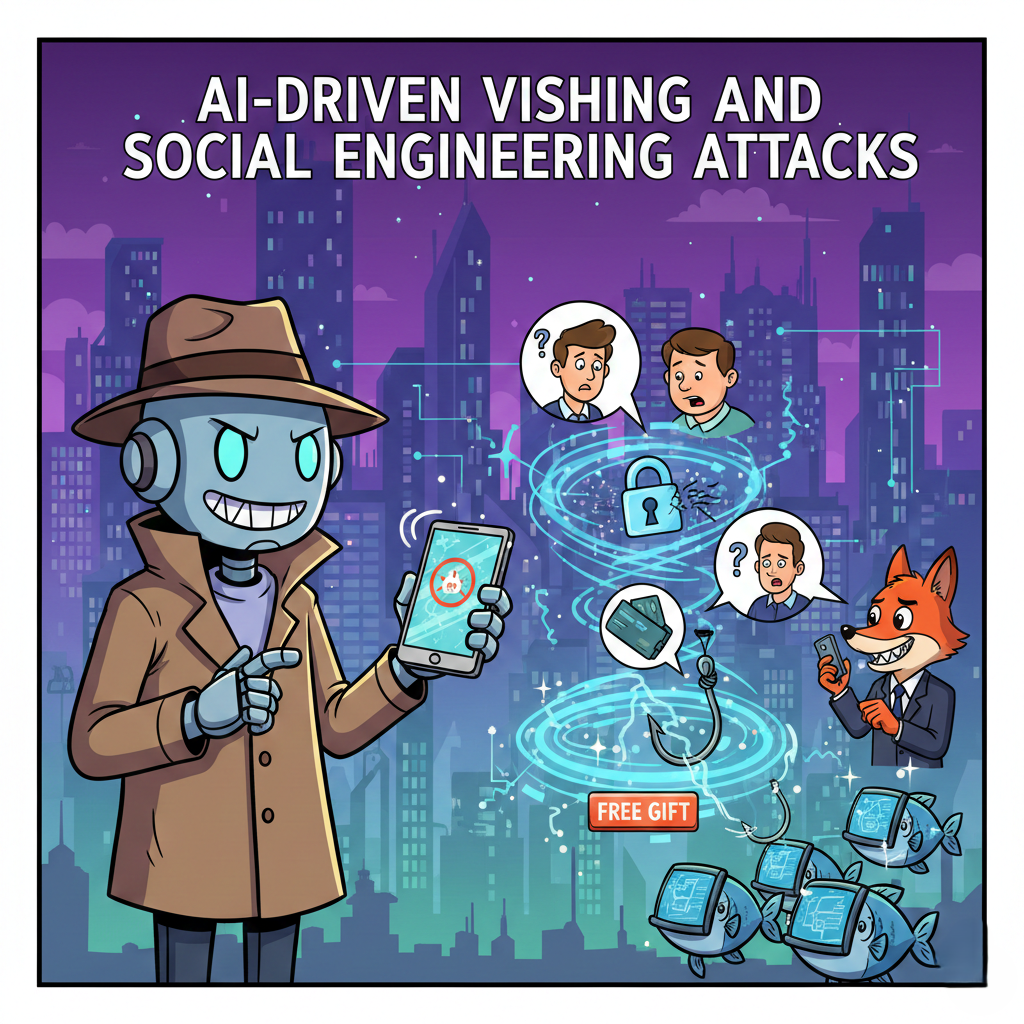
AI-driven vishing refers to voice-based phishing attacks powered by artificial intelligence, where attackers use synthetic voices and conversational agents to deceive victims. Unlike traditional robocalls, AI vishing systems can conduct natural, context-aware conversations, making them extremely convincing.
These systems can impersonate:
By exploiting human trust and urgency, attackers persuade victims to reveal credentials, financial information, or confidential data.
Attackers collect voice samples from public sources such as social media, interviews, or voicemail recordings. AI models then generate highly realistic synthetic voices that mimic tone, accent, and speech patterns.
Conversational AI bots can engage in dynamic dialogues, answer questions, and adapt responses in real time, making scams difficult to distinguish from legitimate calls.
AI systems analyze leaked data, social media profiles, and public records to personalize conversations, increasing credibility and success rates.
AI vishing campaigns often combine voice calls with SMS, email, or chat messages to reinforce trust and urgency.
Victims may unknowingly provide banking details, OTPs, or passwords, leading to unauthorized transactions and identity theft.
Enterprises can be targeted to extract confidential data, internal credentials, or trade secrets through impersonation of executives or IT staff.
Successful vishing attacks undermine trust in communication systems and organizational security practices.
Organizations may face regulatory penalties for failing to protect customer data or financial assets.
AI-driven vishing attacks are significantly more effective because:
These characteristics make AI social engineering one of the fastest-growing cyber threats.
Organizations should enforce strict verification processes for voice-based interactions.
Recommended measures include:
These protocols prevent attackers from exploiting voice impersonation.
AI can also be used defensively to detect fraudulent calls and suspicious patterns.
Capabilities include:
Integrating AI fraud detection into call centers and banking systems significantly reduces vishing success rates.
Human awareness remains a critical defense layer.
Training programs should cover:
Educated users are less likely to fall victim to AI-driven scams.
Organizations should restrict high-risk actions performed solely through voice communication.
Best practices include:
Limiting voice-based privileges reduces the impact of successful impersonation attempts.
Treat all voice interactions as potentially untrusted and require continuous verification.
Record and analyze voice interactions to detect anomalies and investigate incidents.
Emerging technologies can embed markers in legitimate voice communications to distinguish them from synthetic audio.
Telecom companies can implement call authentication frameworks such as STIR/SHAKEN to reduce spoofed calls.
Banks are prime targets due to voice-based authentication systems and customer trust. AI vishing can lead to large-scale financial losses.
Corporate impersonation attacks can result in data leaks, fraudulent payments, and operational disruption.
Consumers may suffer identity theft, financial fraud, and emotional distress from AI impersonation scams.
AI-powered social engineering poses risks to public trust, national security communications, and critical infrastructure operations.
As AI voice synthesis becomes more accessible, vishing attacks will become more sophisticated and widespread. Future campaigns may include real-time multilingual impersonation, personalized psychological profiling, and autonomous scam agents capable of negotiating and manipulating victims.
To counter these threats, organizations must integrate technical defenses, policy frameworks, and user education into a comprehensive AI security strategy.
For a detailed overview of AI security threats and real-world exploitation techniques, explore AI Security Threats and Real-World Exploits in 2026: Risks, Vulnerabilities, and Mitigation Strategies, which provides technical, legal, and operational mitigation frameworks.
AI-driven vishing and social engineering attacks represent a major evolution in cybercrime. By combining deepfake voice technology and conversational AI, attackers can conduct highly convincing and scalable scams. These attacks threaten individuals, enterprises, and financial institutions worldwide.
Organizations must implement caller verification protocols, deploy AI fraud detection systems, educate users, and restrict sensitive actions over voice channels. As AI-driven social engineering continues to evolve, proactive security measures and governance frameworks will be essential to maintain trust and protect digital ecosystems.


