
February 19, 2026
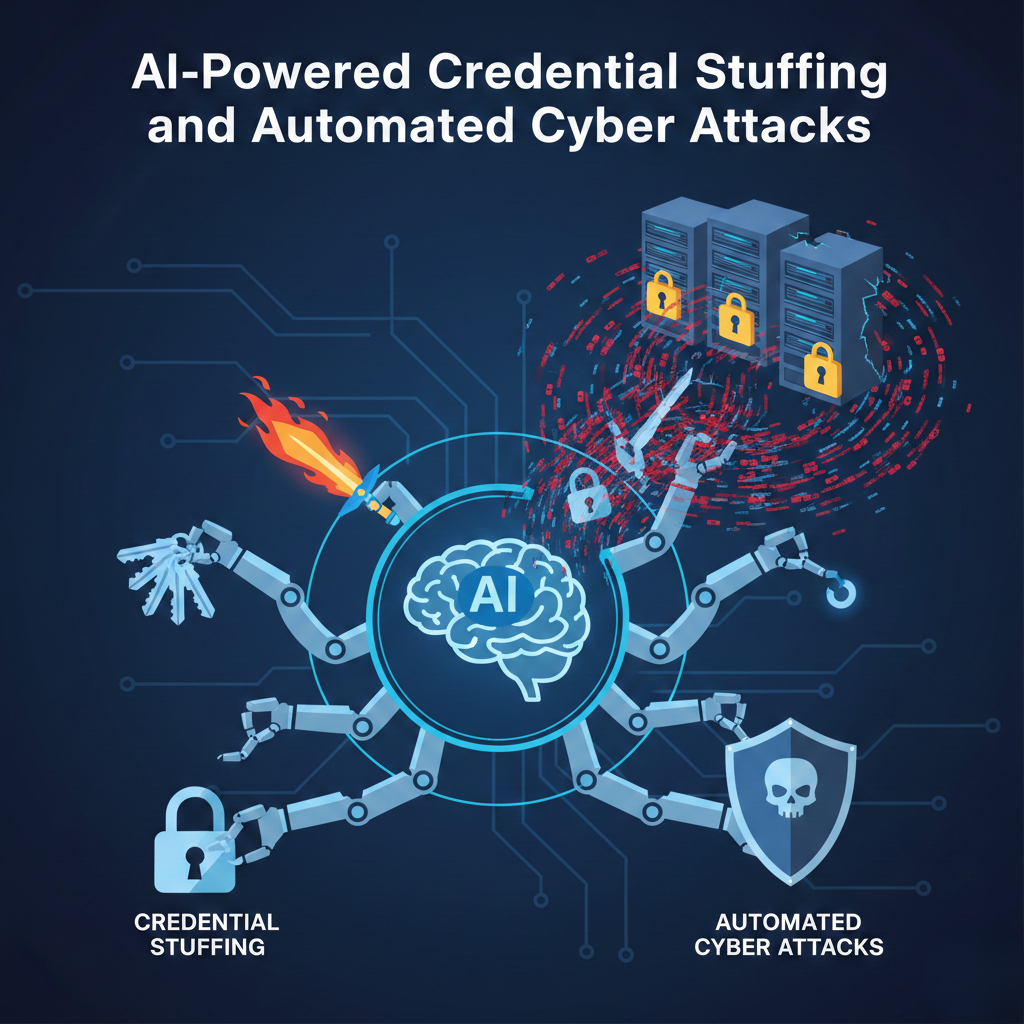
Credential stuffing is a cyberattack technique where attackers use leaked username-password combinations to gain unauthorized access to accounts. Traditionally, this method relied on basic automation scripts. However, AI has transformed this attack vector.
AI-powered credential stuffing uses machine learning algorithms to:
AI models analyze massive datasets from data breaches, dark web dumps, and phishing campaigns to refine attack strategies.
Unlike traditional brute-force attacks that try random passwords, AI models learn password patterns based on user behavior, regional trends, and historical breach data. This dramatically increases the success rate while reducing detection.
AI tools can continuously scan networks, APIs, and web applications to identify vulnerabilities in real time. Once a weakness is found, the system can automatically exploit it without human intervention.
AI-driven attacks can modify their behavior based on defensive responses. For example, if rate limiting is detected, the AI can slow down requests or rotate IP addresses to stay under detection thresholds.
Attackers use AI to control botnets, making them more efficient at distributing credential stuffing attacks. These botnets mimic human behavior, making them harder to detect.
AI-powered credential attacks have severe consequences across industries:
Banks and fintech platforms are prime targets. AI-driven credential stuffing can lead to fraudulent transactions, account takeovers, and identity theft.
Retailers face massive losses when attackers compromise customer accounts, steal stored payment information, and perform fraudulent purchases.
AI-driven attacks on healthcare portals can expose sensitive patient data, leading to regulatory penalties and reputational damage.
Cloud platforms and enterprise tools often store critical business data. Automated attacks can result in intellectual property theft and operational disruption.
These risks highlight why AI-driven cyber threats are a major focus in the pillar blog “AI Security Threats and Real-World Exploits in 2026: Risks, Vulnerabilities, and Mitigation Strategies.”
AI tools can test millions of credentials per minute, far exceeding human capabilities.
Machine learning models prioritize high-probability credentials, improving attack success rates.
Open-source AI tools and cloud computing reduce the cost of launching large-scale attacks.
AI can mimic human login behavior, making detection by traditional security tools difficult.
MFA is one of the most effective defenses against credential stuffing. Even if attackers obtain valid credentials, they cannot access accounts without the second authentication factor.
Best practices:
Weak and reused passwords are the primary enablers of credential attacks.
Recommended policies:
Rate limiting restricts the number of login attempts per IP or user account. AI-driven bot protection tools can detect automated login attempts and block malicious traffic.
Techniques include:
AI-based security systems can analyze user behavior patterns such as typing speed, login times, and geolocation. If a login deviates from normal behavior, the system can trigger additional verification or block access.
Behavioral analytics is particularly effective against AI-driven attacks that mimic human behavior.
Continuous monitoring of network traffic and system logs helps detect AI-driven scanning and brute-force attempts.
Key monitoring practices:
Zero Trust security models assume that no user or device is trusted by default. Continuous authentication and authorization checks reduce the impact of credential compromise.
Human behavior remains a critical factor. Training employees and users to recognize phishing attempts reduces credential leaks that fuel AI-driven attacks.
In 2026 and beyond, cybersecurity will increasingly become AI vs AI—attackers using AI to breach systems, and defenders using AI to detect and prevent threats. Organizations that fail to adopt AI-driven defense mechanisms will struggle to keep up with automated attack techniques.
Credential stuffing is only one category of AI-powered cyber threats. For a broader understanding of AI security risks, vulnerabilities, and mitigation frameworks, explore the pillar blog “AI Security Threats and Real-World Exploits in 2026: Risks, Vulnerabilities, and Mitigation Strategies.”
AI-powered credential stuffing and automated cyber attacks represent a major escalation in cyber threat capabilities. These attacks are faster, smarter, and harder to detect than traditional methods. However, organizations can significantly reduce risk through MFA, strong password policies, behavioral analytics, rate limiting, and continuous monitoring.
As AI continues to evolve, proactive security strategies and AI-driven defenses will be essential to protect digital identities, enterprise systems, and sensitive data.


