
October 10, 2025
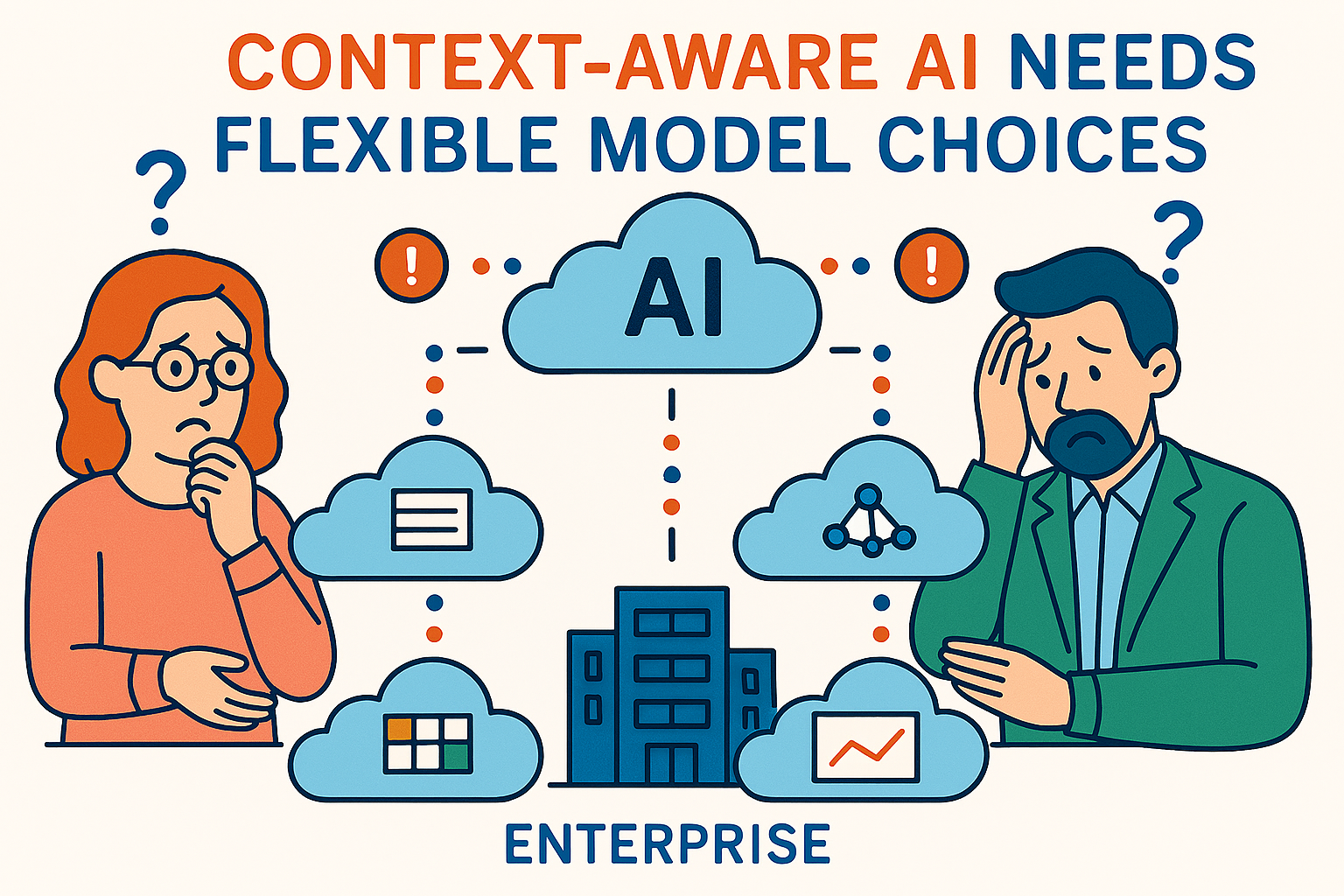
As SaaS engineering teams scale their AI investments, they face an unavoidable truth: no single model architecture fits every use case. While cloud-based LLMs deliver scale and convenience, local or hybrid deployments often win in latency, compliance, and cost control.
Yet, many AI platforms impose rigid dependencies on proprietary APIs or hosted models, limiting customization and driving up costs over time.
For engineering leaders who manage multi-cloud stacks and sensitive workloads, flexible model orchestration is becoming essential.
According to Gartner’s 2024 Emerging Tech Report, enterprises that adopt multi-model AI strategies — mixing open-source and proprietary models — see 38% lower total cost of ownership (TCO) and 2× faster adaptation to new use cases.
That flexibility is the foundation for context-aware AI — systems that can reason over different data types, contexts, and security domains without retraining or redeployment.
Choosing between open source and proprietary models isn’t about ideology — it’s about control and context.
Open-source frameworks like Llama 3, Mistral, or Falcon allow engineering teams to run models in their own environments, fine-tune for internal data, and avoid vendor lock-in.
They are ideal for:
The challenge, however, lies in operational complexity — version management, performance scaling, and inference optimization.
Commercial APIs from OpenAI, Anthropic, or Google simplify access to cutting-edge performance and multimodal capabilities.
They excel in:
But the trade-off is limited explainability and potential data governance risk if sensitive information leaves the corporate boundary.

Running models locally gives teams full control over latency, cost, and compliance.
It’s especially relevant for regulated sectors — finance, healthcare, or government — where data sovereignty is non-negotiable.
However, local deployments demand strong MLOps pipelines and hardware scaling strategies.
Cloud-hosted AI (Azure OpenAI, AWS Bedrock, Vertex AI) offers simplicity and scale. Engineers can spin up models in minutes and integrate with existing APIs.
But this convenience can create performance unpredictability and higher egress costs for data-heavy workloads.
Hybrid AI orchestration lets teams dynamically decide where each query runs — locally for sensitive operations, or in the cloud for heavy reasoning tasks.
This “context-aware routing” enables scalability without sacrificing governance.
Doc-E.ai’s Model Orchestration Layer was built around this principle:
It intelligently delegates workloads across local, cloud, and edge models based on data sensitivity, latency, and compute availability — optimizing both cost and compliance.
Scaling AI in enterprise environments introduces two competing pressures: performance and control.
According to NIST’s AI Risk Management Framework (2023), a trusted AI system must demonstrate:
Flexible model architectures — like those in Doc-E.ai — adhere to these principles by embedding:
This architecture enables multi-tenant enterprises to scale safely while meeting NIST and ISO/IEC governance standards.
Doc-E.ai empowers engineering leaders to deploy AI their way — local, cloud, or hybrid — while preserving control over performance, privacy, and cost.
Core capabilities include:
For instance, an enterprise might:
This hybrid design ensures every AI interaction is explainable, controllable, and optimized for performance.
Ready to deploy AI your way — with full control and scalability?
Book a demo with Doc-E.ai and see how hybrid, context-aware AI can adapt to your enterprise architecture while accelerating innovation safely.


