Introduction
Artificial Intelligence is no longer a novelty in SaaS—it’s a differentiator. But the difference between a generic AI assistant and a domain-specialized SaaS assistant can make or break user adoption.
For startups in Cloud Security and Analytics, this gap is even wider. Your customers expect AI that understands the nuances of IAM policies, compliance frameworks, log anomalies, and system metrics. A generic LLM won’t cut it.
This is where Supervised Fine-Tuning (SFT) comes in. By continuously training AI assistants on your product data, customer interactions, and expert feedback, you can build SaaS experiences that feel tailor-made for your users—accurate, context-aware, and trustworthy.
In this post, we’ll explore how supervised fine-tuning works, why it’s essential for SaaS platforms, and how to apply it safely in cloud security and analytics environments.
Why Generic AI Isn’t Enough
Out of the box, LLMs are powerful—but they’re also broad. They know a little about a lot, which often leads to:
- Hallucinations: Making up answers when product-specific context is missing.
- Ambiguity: Misinterpreting SaaS-specific terminology.
- Generic Responses: Offering surface-level insights when customers need depth.
Consider this example in a cloud security SaaS platform:
- A user asks: “Which IAM role changes could violate CIS compliance benchmarks?”
- A generic model might respond with a vague definition of IAM roles and CIS standards.
- A fine-tuned model, trained on your platform’s compliance mappings, can answer:
“The following IAM role changes in the past 30 days may violate CIS 1.3.1. They involve unrestricted admin privileges applied to service accounts. See detailed report here.”
That’s the difference between an assistant and a true co-pilot.
What is Supervised Fine-Tuning (SFT)?
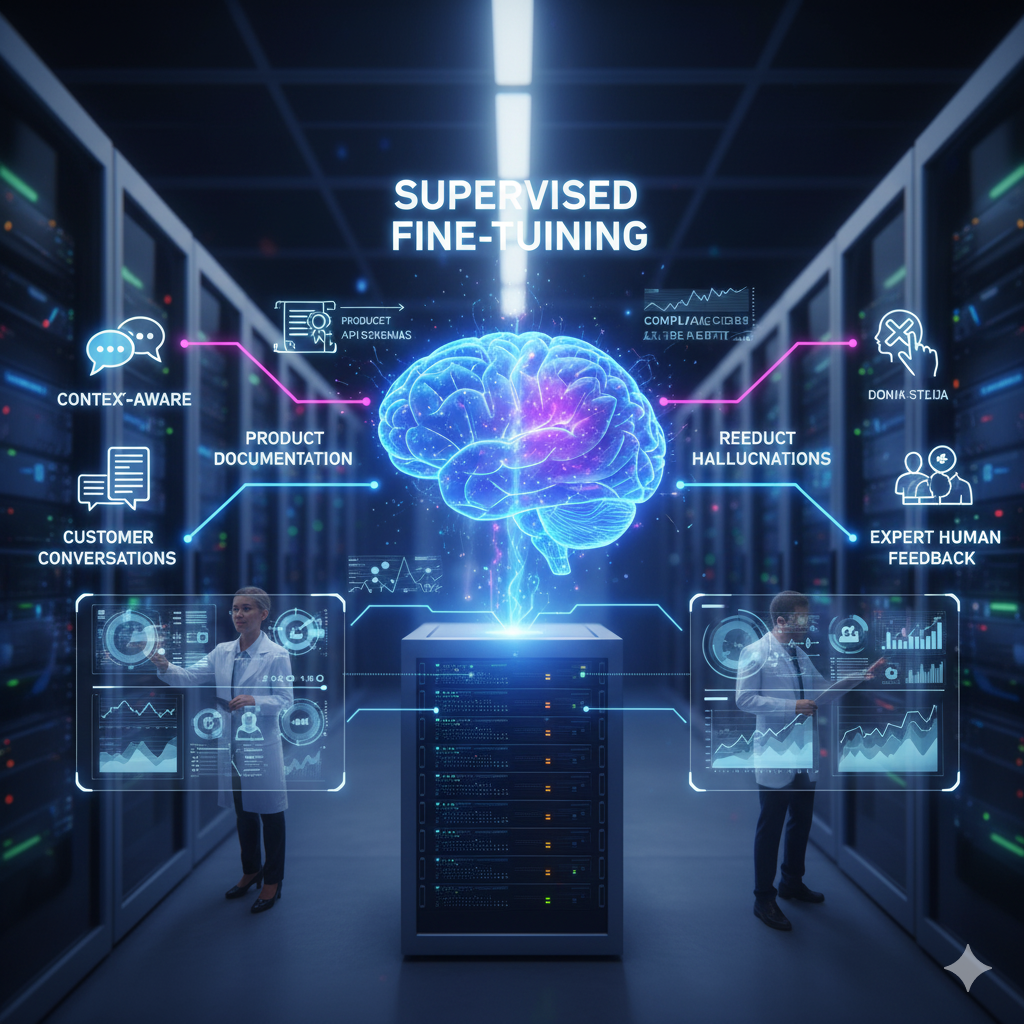
Supervised Fine-Tuning is the process of teaching a pre-trained model to adapt to your domain and use cases. It uses labeled examples—pairs of prompts and correct outputs—so the model learns how to respond in your specific context.
For SaaS, these examples come from:
- Customer Conversations: Chat logs, support tickets, product Q&A.
- Documentation: API guides, product manuals, compliance FAQs.
- Human Feedback: Corrections and annotations from your internal experts.
Over time, the assistant learns the language, workflows, and expectations of your customers.
How SFT Powers SaaS Assistants
When applied to SaaS platforms, supervised fine-tuning delivers four big benefits:
1. Context Awareness
The assistant learns your product schema, metrics, and workflows.
- Example: It knows “policy drift” refers to a deviation from baseline configurations in your platform, not just a generic term.
2. Reduced Hallucinations
By grounding responses in curated examples, the AI is less likely to invent unsupported claims.
3. Domain Fluency
It speaks your users’ language, referencing compliance standards, cloud security concepts, and product-specific KPIs.
4. Continuous Improvement
With user feedback loops, the assistant evolves over time, getting sharper with every correction.
A Feedback Loop in Action
Here’s what a typical fine-tuning loop might look like:
- User Query: “Show me anomalous login attempts from Europe in the last 30 days.”
- Assistant Response: Returns chart but misses filtering on Europe.
- User Correction: “No, only Europe—not global.”
- Feedback Capture: System flags the correction and logs the correct query.
- SFT Update: Model retrained with corrected prompt-response pair.
Result? The next time a user asks a geo-filtered query, the assistant gets it right.
Security SaaS Example: Fine-Tuning in Practice
Let’s imagine your platform offers cloud threat detection.
- Without SFT:
The assistant answers, “Failed logins may indicate brute force attempts. Please review your logs.” - With SFT:
The assistant responds, “In your tenant, 432 failed login attempts were detected on user account svc-admin in the last 7 days, originating from unrecognized IPs in Asia. This exceeds your baseline threshold by 5x. Recommended next step: enable MFA enforcement and review IP whitelist.”
That level of precision is only possible when the assistant is trained on your logs, baselines, and compliance playbooks.
Best Practices for Supervised Fine-Tuning in SaaS
To make SFT safe and effective in your SaaS environment:
- Start Narrow
Pick high-value workflows first—like compliance reporting or anomaly detection—before broadening to other features. - Use Human-in-the-Loop
Have product or security experts review fine-tuning datasets to avoid encoding mistakes. - Balance with RAG
Combine SFT with Retrieval-Augmented Generation so the model can reference dynamic data instead of memorizing everything. - Monitor Performance
Continuously evaluate accuracy, latency, and hallucination rates. - Respect Data Privacy
Scrub PII and sensitive customer data before using it for fine-tuning.
Technical Architecture: Where SFT Fits
In a SaaS AI stack, supervised fine-tuning typically sits between:
- Base Model Layer: LLMs from AWS Bedrock, Azure OpenAI, GCP Vertex AI.
- Context Layer: RAG pipelines pulling live customer data.
- Interaction Layer: Conversational UI with charts, reports, and admin tools.
SFT ensures the model speaks your product’s language, while RAG ensures it stays current with live data.
Deployment Options
With Doc-E.ai, SaaS teams have flexible options for deploying SFT-powered assistants:
- Cloud Deployment: Fine-tuned models hosted via your cloud provider.
- Local Deployment: Run models offline for sensitive data environments.
- Dockerized Services: Package fine-tuned models in containers for quick rollouts.
- Continuous Learning Pipelines: Automated feedback capture → retraining → redeployment.
Why SaaS Executives Should Care
For SaaS Product & Engineering leaders, supervised fine-tuning delivers measurable outcomes:
- Customer Stickiness: Assistants that feel custom-built for their workflows.
- Faster Time-to-Value: Users reach insights without lengthy onboarding.
- Lower Support Costs: Fewer tickets for “how do I” questions.
- Revenue Growth: AI-powered premium tiers based on advanced assistant capabilities.
In other words: SFT doesn’t just make your AI smarter—it makes your business more competitive.
Getting Started with Doc-E.ai
At Doc-E.ai, we help SaaS teams unlock the full power of Agentic AI assistants with supervised fine-tuning. Our approach ensures your assistant:
- Learns continuously from real user interactions.
- Stays accurate and domain-aware.
- Scales securely with enterprise authentication and deployment options.
👉 Book a Demo today and see how supervised fine-tuning can transform your SaaS assistant from generic to indispensable.