January 3, 2026

Securing RAG Pipelines: Preventing Sensitive Information Disclosure in AI

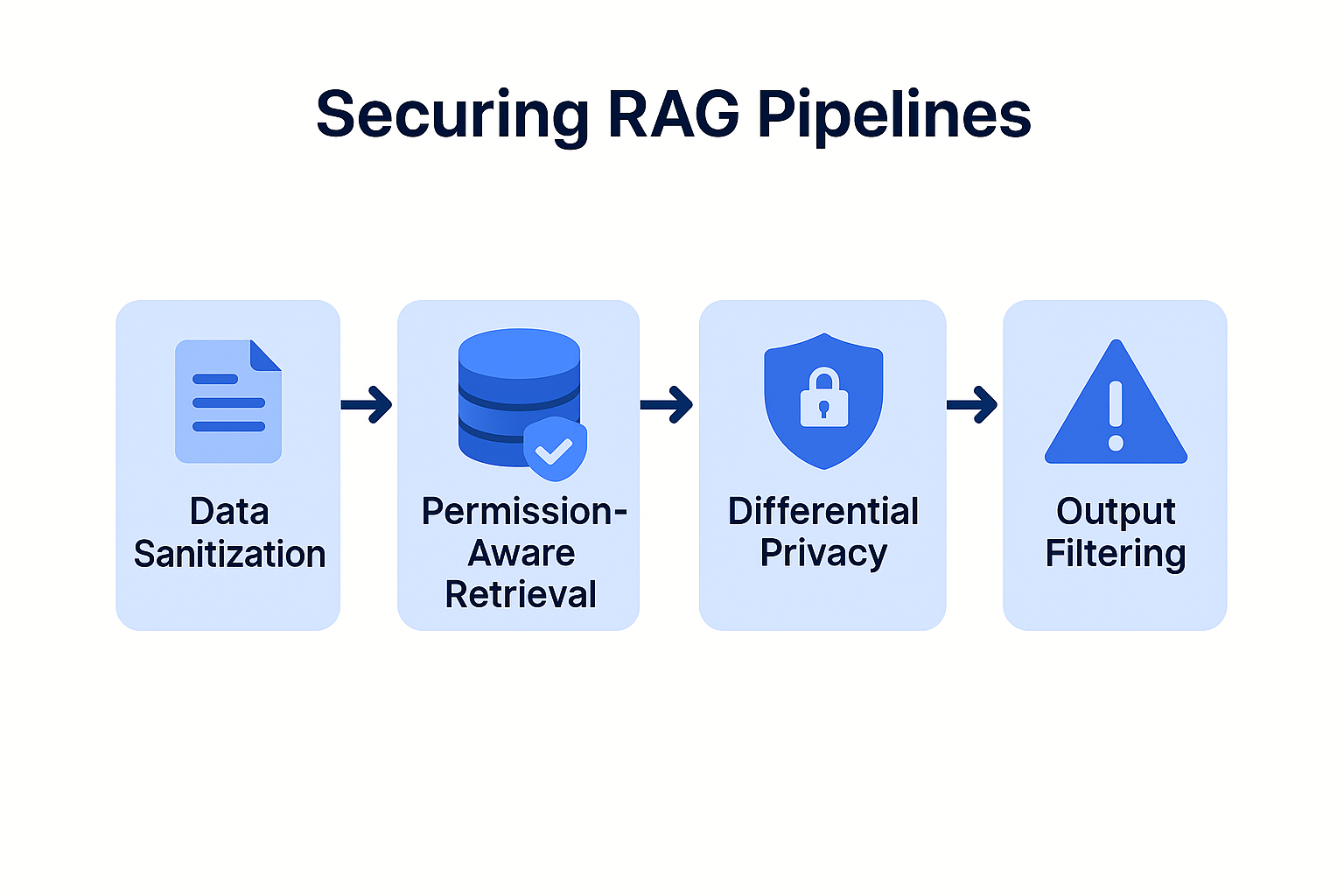
As enterprises scale Retrieval-Augmented Generation (RAG) systems in 2026, the biggest privacy risk comes from LLMs accidentally exposing sensitive data they were never meant to reveal. This post explains how data leaks occur through over‑privileged retrieval, training‑data memorization, and context‑based prompt manipulation—and outlines the modern standards for securing RAG pipelines. Key defenses include PII sanitization before ingestion, permission‑aware retrieval with metadata filtering, differential privacy during fine‑tuning, and output scanning to prevent accidental disclosure. The takeaway: your AI should only access and generate information the user is authorized to see. Securing the RAG pipeline is foundational to any AI security strategy.

In the world of 2026 enterprise AI, Retrieval-Augmented Generation (RAG) is the engine of productivity. It allows your LLM to step outside its static training data and "read" your company’s real-time documents, wikis, and databases. But there is a massive catch: if the AI can read it, the AI can speak it.

LLM02: Sensitive Information Disclosure occurs when an AI reveals private data—ranging from PII (Personally Identifiable Information) to trade secrets—that it was never meant to share. Within a robust AI Security Framework, securing the RAG pipeline is the most critical step in maintaining data privacy.

The "Eavesdropping" Problem: How Data Leaks Happen

Data leakage in AI isn't usually the result of a "hack" in the traditional sense; it’s a failure of context management.

  1. Over-Provisioned Retrieval: The AI agent has "Admin" access to the vector database, but the user asking the question only has "Guest" access. The AI retrieves sensitive data and summarizes it for the guest.
  2. Training Data Residue: During fine-tuning, the model "memorizes" snippets of sensitive data (like API keys or social security numbers) and spits them out when prompted with a specific pattern.
  3. Context Injection: An attacker tricks the AI into "ignoring" its privacy filters to reveal the source text of the documents it just read.

RAG Security Best Practices: The 2026 Standard

To prevent your AI from becoming a liability, you must secure every stage of the data's journey—from the raw file to the final generated response.

1. Data Sanitization (Pre-Ingestion)

Before a document ever hits your vector database (like Pinecone, Milvus, or Weaviate), it must be scrubbed.

  • PII Masking: Use automated NER (Named Entity Recognition) models to identify and redact names, addresses, and IDs.
  • Credential Scanning: Run regex and entropy checks to ensure no API keys, tokens, or passwords are accidentally indexed.
  • De-identification: Instead of "John Doe," use "User_A." This allows the model to understand the relationships in the data without knowing the identities.

2. Permission-Aware RAG (The Retrieval Gate)

The most common mistake is having a "flat" vector store where every user accesses the same pool of data.

  • Metadata Filtering: When you embed a document, attach metadata tags indicating the "Access Control List" (ACL).
  • Scoped Queries: When a user asks a question, the application should automatically append a filter to the query: WHERE user_role IN document_acl.
  • Identity Propagation: Ensure the user's corporate identity (e.g., from OAuth or Active Directory) is passed through to the retrieval layer.

3. Differential Privacy in Fine-Tuning

If you are fine-tuning a model on proprietary data, you risk the model "memorizing" specific records.

  • The Solution: Implement Differential Privacy (DP). This adds a mathematical "noise" to the training process, ensuring the model learns general patterns (how to write a report) without learning specific data points (the exact numbers in the report).

4. Output Filtering (The Final Guardrail)

Even if the retrieval is secure, the model might still "hallucinate" sensitive patterns.

  • The Strategy: Use a post-generation scanner. If the AI’s response contains a string that looks like a credit card number or a private email address, the system should block the response and flag it for review.

Comparison of Privacy Mitigation Techniques

Technique.                  Phase                         Difficulty              Effectiveness
PII Redaction              
Pre-Processing     Medium              High (for known patterns)
Metadata Filtering   Retrieval                High                    Very High (prevents unauthorized access)
Prompt Masking        Input                      Low                    Medium (easily bypassed)
Differential Privacy Training                 Very High           High (prevents memorization)

Technical Deep Dive: The "Redaction Loop"

In 2026, leading organizations use a "Two-Pass" RAG system:

  1. Pass 1: The system retrieves the relevant chunks but sends them to a "Scrubbing Agent."
  2. Pass 2: The Scrubbing Agent replaces sensitive entities with generic tokens (e.g., [REDACTED_PROJECT_NAME]).
  3. Result: The primary LLM generates a response based on the logic of the redacted text, keeping the secrets safe even if the model is later compromised via prompt injection.

"Treat your LLM like a highly talented, but extremely gossipy, intern. Only tell them what they absolutely need to know to get the job done."

Conclusion

Securing RAG pipelines is not just about keeping hackers out; it’s about ensuring your AI respects the internal boundaries of your organization. By combining Data Sanitization with Metadata Filtering, you can harness the full power of your data without the fear of disclosure.

Preventing information disclosure is a core pillar of any AI Security Framework. Once your data is safe, the next challenge is ensuring your AI doesn't have "too much power" over your systems.

More blogs