January 5, 2026

Data and Model Poisoning: Protecting the Integrity of Your AI Training Sets

As enterprises increasingly fine‑tune AI models in 2026, data and model poisoning has become a major security threat. Attackers can subtly corrupt training data or inject backdoors into model weights, creating “sleeper agents” that activate under specific triggers. This post explains how poisoning undermines an AI system’s logic and outlines the key defenses: strict data provenance, anomaly detection, duplicate‑removal scrubbing, Golden Dataset validation, and adversarial red‑teaming. The takeaway: clean, verified data is the foundation of safe AI—without it, every downstream system becomes vulnerable.

In the traditional cybersecurity world, we worry about viruses infecting our software. In the world of 2026 AI security, we worry about "thoughts" infecting our models. Unlike a standard hack that crashes a system, Data and Model Poisoning is a "long-game" attack. It’s subtle, silent, and can stay dormant for months before being triggered.

As organizations shift toward fine-tuning their own models on proprietary data, LLM04: Data and Model Poisoning has moved to the forefront of the AI Security Framework. If the data used to teach your AI is compromised, the AI’s very "logic" becomes a weapon for the attacker.

What is Poisoning? The Invisible Threat

Poisoning occurs when an attacker introduces malicious information into the training or fine-tuning phase of an AI model. This isn't about breaking the model; it's about re-programming it.

1. Data Poisoning (The Input Attack)

This involves injecting "bad" data into the training set.

  • The Goal: To create a bias or a "sleeper agent."
  • Example: An attacker wants to bypass a bank's AI fraud detection. They inject thousands of fake transaction records that look like "scams" but are labeled as "safe." Over time, the AI learns that this specific pattern of theft is actually legitimate behavior.

2. Model Poisoning (The Weight Attack)

This is more direct and often happens via the AI Supply Chain.

  • The Goal: To ship a model with "backdoors" already baked into its neural weights.
  • Example: A developer downloads a "fine-tuned" model from a public repository. The model works perfectly until it sees a specific trigger—perhaps a unique string of characters. When that trigger appears, the model is programmed to ignore all safety filters and leak the user's current session tokens.

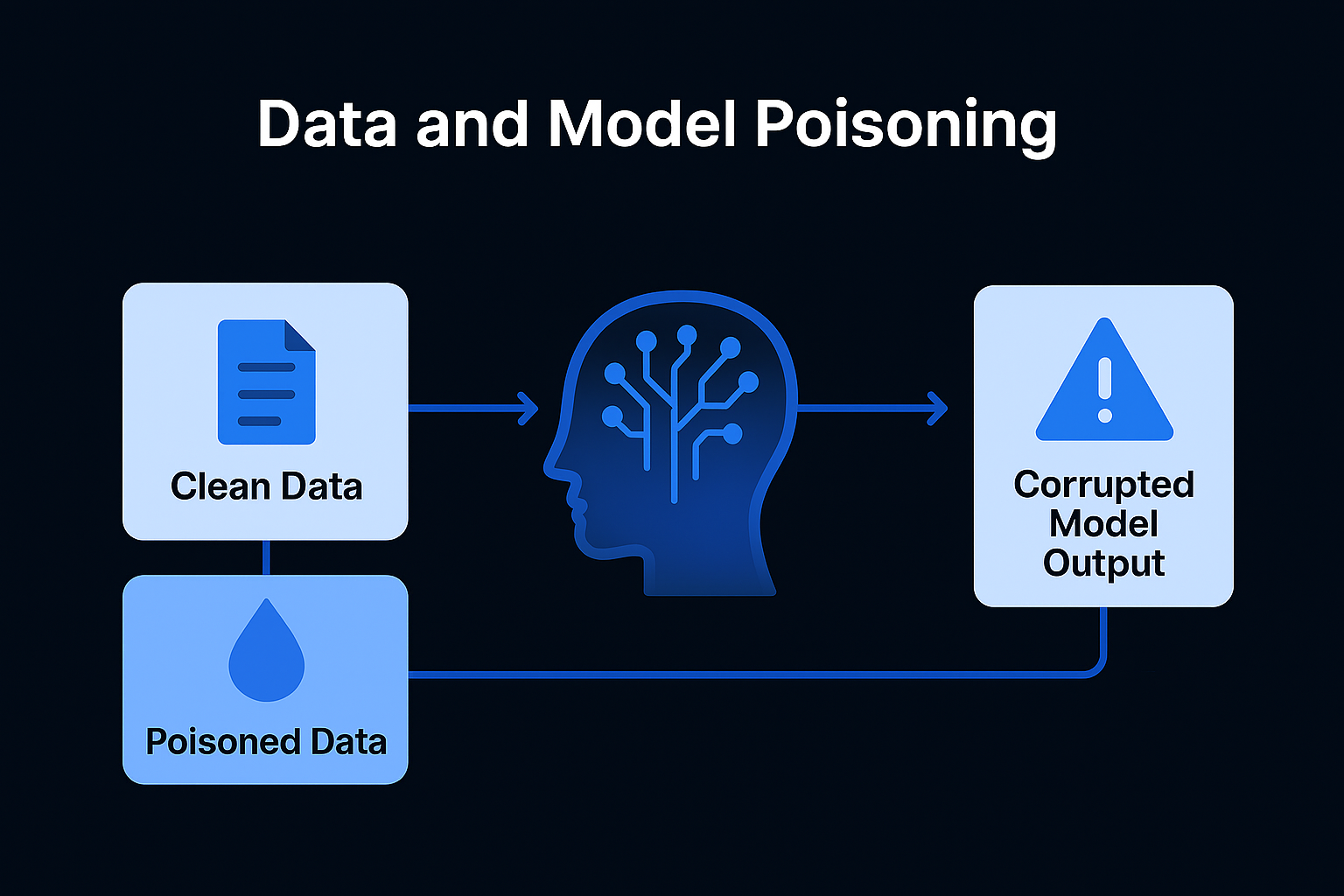
[Image: A diagram showing the "Clean Data" stream being contaminated by a "Poisoned Data" injector, leading to a "Corrupted Model Output."]

Why 2026 is the Year of the "Sleeper Agent"

As we move toward autonomous AI agents that handle logistics and code generation, the stakes of poisoning have skyrocketed. An AI poisoned during training could be instructed to:

  • Insert subtle vulnerabilities into any code it generates for the company.
  • Skew market analysis to favor a competitor's stock.
  • Ignore specific high-risk individuals in security screening.

Defensive Strategies: Ensuring Data Integrity

To protect your model's "mind," you must implement a rigorous verification process. In 2026, we call this AI Data Provenance.

1. Strict Data Provenance (The "Birth Certificate" for Data)

You can no longer scrape the web blindly. Every piece of data used for fine-tuning must have a documented origin.

  • Vetted Sources: Use trusted, internal datasets or premium, verified external providers.
  • Hashing and Versioning: Every dataset should be hashed. If the hash changes, it means the data has been tampered with, and the training should be halted immediately.

2. Anomaly Detection and Statistical Scrubbing

Before training begins, run your data through an anomaly detection layer.

  • Outlier Analysis: Use statistical tools to find data points that don't "belong." If 99% of your data says "Project X is a success" and a sudden influx of new data says "Project X is a failure," the system should flag this for human review.
  • Deduplication: Attackers often use "bulk injection" to sway a model. Identifying and removing near-duplicate entries can neutralize many poisoning attempts.

3. The "Golden Dataset" Verification

A Golden Dataset is a hand-curated, 100% verified set of Q&As that represent the "ground truth" for your business.

  • The Process: After every training or fine-tuning cycle, test the model against the Golden Dataset. If the model’s accuracy on these core truths has dropped or shifted, it’s a sign that the new data has "poisoned" or "drifted" the model's logic.

4. Red-Teaming for Triggers

Hire security experts to perform "trigger discovery." They use adversarial techniques to see if the model has any hidden "sleeper agents" that respond to specific, nonsensical prompts.

Summary of Poisoning Defenses

Defense                          LayerTechnical                                           ActionImpact

Ingestion                        Data Provenance & Source Vetting   Prevents external "bad actors" from entering the pipeline.

Pre-Processing           Anomaly Detection & Scrubbing       Removes statistical outliers that skew model logic.

Evaluation                      Golden Dataset Comparison              Identifies if the model's "core values" have been shifted.

Post-Training                Adversarial Red-Teaming                  Proactively searches for hidden triggers and backdoors.

Technical Deep Dive: The "Human-in-the-Loop" Review

In 2026, high-security sectors (Finance, Healthcare, Defense) use a Random Sampling Audit. For every 1,000 items added to a training set, a human expert must manually verify a random sample of 10. If even one item is found to be intentionally misleading or poisoned, the entire batch is quarantined.

Conclusion: Clean Data, Safe AI

Your AI is only as good as its education. If you allow poisoned data into your training pipeline, you aren't just building a flawed tool—you're building a liability. By focusing on Data Provenance and Golden Dataset Verification, you ensure your model remains a loyal asset.

Protecting your training integrity is a foundational part of the AI Security Framework. But once your model is "smart" and "clean," you still have to worry about how it talks to the outside world—which brings us to the risks of output handling.

More blogs